Spring is the most critical season for any beekeeper. After months of winter clusters, the first warm days of April bring both opportunity and risk. As a beekeeper with over 15 years of experience, I have learned that a successful honey harvest in July is won or lost during the first thorough inspections of April.
In this guide, we will dive deep into the essential steps of spring hive management, ensuring your colonies are healthy, queen-right, and ready to expand.
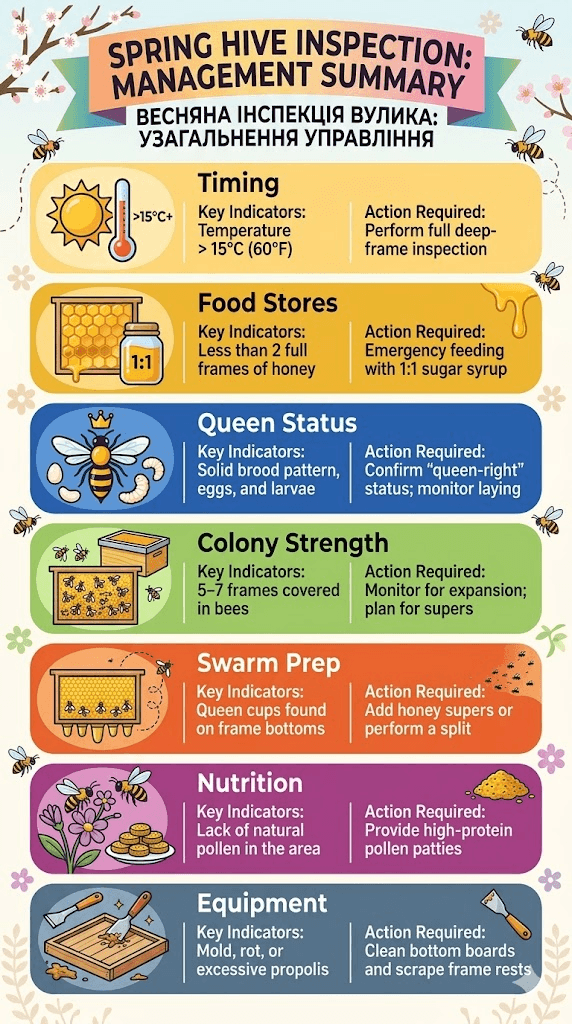
1. Timing Your First Deep Inspection
One of the most common mistakes beginners make is opening the hive too early. In regions like the northern United States or Eastern Europe, early April weather can be deceptive.
- The Golden Rule: Only perform a full deep-frame inspection when the temperature is at least 15°C (60°F) and the wind is calm.
- Why? Opening a hive in cold or windy weather can “chill the brood,” killing the next generation of bees and setting the colony back by weeks.
Before you crack the propolis seal, observe the entrance. Are bees bringing in bright orange or yellow pollen? This is the first sign of a healthy, growing colony.
2. The Essential Spring Inspection Checklist
When you finally open the hive, you need to work quickly but methodically. Here are the five “pillars” of spring inspection:
A. Assessing Food Stores
By April, many colonies are at their highest risk of starvation. They are raising brood, which consumes massive amounts of energy, but the “nectar flow” might not have fully started yet.
- What to look for: At least two full frames of honey.
- Action: If the hive feels light, you must provide emergency feeding (1:1 sugar syrup) to bridge the gap until the dandelions and fruit trees bloom.
B. Evaluating the Queen’s Performance
You don’t necessarily need to see the queen, but you must see her work.
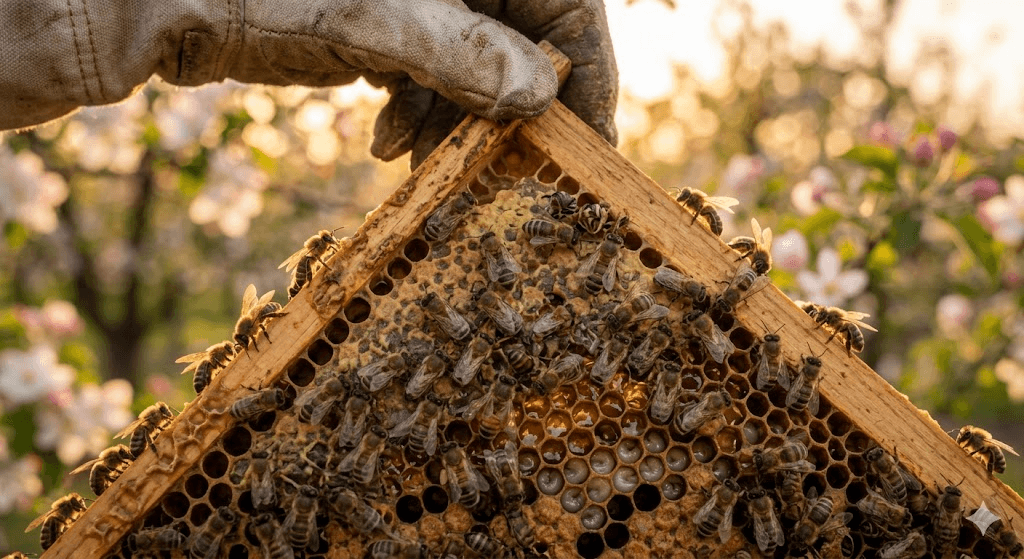
- Brood Pattern: Look for a “solid” pattern of capped brood. A spotty, “shotgun” pattern may indicate an aging queen or disease.
- Evidence of Life: Search for eggs (tiny white grains at the bottom of cells) and “C-shaped” pearly white larvae. This confirms the queen has been active within the last three days.
C. Colony Strength and Population
Count the “seams” of bees (the spaces between frames filled with bees). A strong spring colony should cover 5–7 frames in a deep box. If you see only 2–3 frames of bees, consider “equalizing” by moving a frame of capped brood from a stronger hive or combining weak colonies.
D. Disease and Pest Scouting
April is the time to check for Varroa mites and signs of Nosema (bee diarrhea, often seen as brown streaks on the hive front).
- Varroa Check: Perform a sugar shake or alcohol wash. Early treatment prevents a population explosion in mid-summer.
- Brood Health: Cappings should be convex and chocolate-brown. Sunken or perforated cappings could signal American or European Foulbrood.
3. Reversing Brood Boxes: To Do or Not to Do?
In a standard Langstroth setup, the cluster often moves to the top box during winter, leaving the bottom box empty.
- The Technique: Many beekeepers “reverse” the boxes, putting the empty one on top.
- The Benefit: This encourages the queen to move upward and expand the brood nest, which is a natural swarm prevention tactic.
- Warning: Only reverse if the cluster is entirely in the top box. Do not “split” a brood nest that spans across both boxes, as this can chill the brood.
4. Swarm Prevention: Thinking Two Steps Ahead
Bees don’t think about today; they think about three weeks from now. As the dandelion flow begins, a strong colony can become crowded very quickly.
- Check for Queen Cells: Look at the bottom of the frames for “swarm cups.” If they contain eggs or larvae, the colony is preparing to leave.
- Providing Space: If 70% of your frames are covered in bees and brood, it is time to add your first honey super. Giving them “work to do” (drawing out foundation) is the best way to keep the cluster together.
5. Record Keeping: The Teacher’s Approach
As an educator, I cannot stress this enough: Take notes. Every hive is an individual. Use a notebook or a mobile app to track:
- Queen age and temperament.
- Amount of stores provided.
- Varroa count results.
- Date of the first honey super addition.
This data is invaluable when you compare your results year over year.
Conclusion
Spring management is an art that requires patience and observation. By ensuring your bees have enough food, a healthy queen, and plenty of space, you are setting the stage for a record-breaking honey season.
Remember, at Foxats, we believe that beekeeping is a journey of continuous learning. Listen to your bees—they are the best teachers you will ever have.
6. Nutritional Supplements and Pollen Substitutes
While sugar syrup provides the necessary carbohydrates for energy, it does not provide the protein required for heavy brood rearing. In many temperate regions, a “pollen gap” occurs in April—a period where the weather is warm enough for flight, but the local flora hasn’t yet produced sufficient high-quality pollen.
The Role of Protein in Larval Development
A developing larva requires a steady diet of royal jelly and bee bread, both of which are high in amino acids. If natural pollen is scarce, nurse bees will deplete their own body fat stores (vitellogenin), leading to a shorter lifespan and a “spring dwindle” in the colony population.
Implementing Protein Patties
Strategic placement of protein patties directly above the brood nest can accelerate colony expansion. It is essential to monitor consumption rates:
- Rapid consumption: Indicates a healthy, growing brood nest with high demand.
- Slow consumption: May suggest a queen-related issue or a low population of nurse bees.
- Caution: Unconsumed patties can attract small hive beetles in warmer climates. Only provide what the bees can cover and protect.
7. Equipment Integrity and Sanitation Protocols
Spring is the optimal window for performing a “hardware audit.” The high humidity of winter can cause wooden components to swell, rot, or develop mold, which can compromise the structural integrity of the hive and the health of the bees.
Cleaning the Bottom Board
Debris, dead bees, and wax cappings accumulate on the bottom board over winter, creating a breeding ground for pathogens. A standard protocol involves:
- Temporarily lifting the brood boxes.
- Scraping the bottom board clean of all organic matter.
- Inspecting the wood for signs of rot or carpenter ant activity. A clean floor improves ventilation and reduces the workload for house-cleaning bees.
Propolis Management and Frame Mobility
Over time, bees coat every surface with propolis. In the spring, it is highly recommended to scrape excess propolis from the frame rests (the “rabbit” joints). Maintaining “bee space” (roughly 6mm to 9mm) is critical. If frames become glued together, it leads to accidental bee crushing during future inspections, which can trigger defensive behavior or, worse, result in the accidental death of the queen.
8. Phenology: Synchronizing Hive Management with Local Flora
Experienced apiculturists rely more on phenology—the study of periodic plant and animal life cycle events—than on a fixed calendar. Because weather patterns shift annually, the bees’ biological clock is tied to the blooming of specific “indicator” plants.
Key Indicator Plants
- The Dandelion Bloom: Generally signifies the point where the colony can become self-sufficient. This is often the signal to stop supplemental feeding and prepare for the first major nectar flow.
- Fruit Tree Bloom (Apples, Cherries): Represents a period of explosive brood growth. If a hive is not given adequate space (supers) during this window, the risk of swarming increases by 70-80%.
- Maple and Willow: Essential early-season sources for stimulating the queen to begin her peak laying cycle.
Environmental Monitoring
By observing which species are in bloom, a beekeeper can predict the “nectar flow” with high accuracy. This synchronization allows for the precise timing of adding honey supers, ensuring that the bees have storage space ready the moment the flowers begin to “weep” nectar.
Summary of Spring Objectives
Successful spring management is defined by three metrics: Health, Space, and Nutrition. A colony that enters May with a young, vigorous queen, a low mite count, and a well-ventilated, clean hive is positioned to maximize the upcoming honey flow. Consistency in these technical protocols ensures long-term apiary sustainability and high-yield results.