The success of a beekeeping operation is not measured by the honey harvested in July, but by the number of living colonies present in April. Winter is the ultimate auditor of hive management. It is a period of intense physiological and thermodynamic stress where the colony must transition from an expansive, foraging entity into a tightly clustered, heat-generating organism. For the professional manager, overwintering is not a period of dormancy, but a complex challenge of moisture regulation, carbohydrate placement, and the preservation of the “diutinus” bee generation. Understanding that cold does not kill bees—moisture and starvation do—is the fundamental shift required to master northern apiculture.
To survive six months of freezing temperatures, the colony relies on a remarkable feat of social heating. They do not heat the inside of the hive; they heat the cluster itself. This biological engine requires a staggering amount of fuel and a precise structural environment to prevent the accumulation of lethal metabolic byproducts.
The Physics of the Cluster: Mantle and Core Dynamics
The honeybee cluster is a dynamic, self-insulating sphere. As temperatures drop below 10°C (50°F), the bees form a multi-layered structure. The outer layer, or the “mantle,” consists of tightly packed bees with their heads facing inward, creating a living wall of insulation. Inside this mantle is the “core,” where bees actively vibrate their wing muscles to generate heat, maintaining a core temperature that can reach 35°C (95°F) even when the outside air is well below zero.
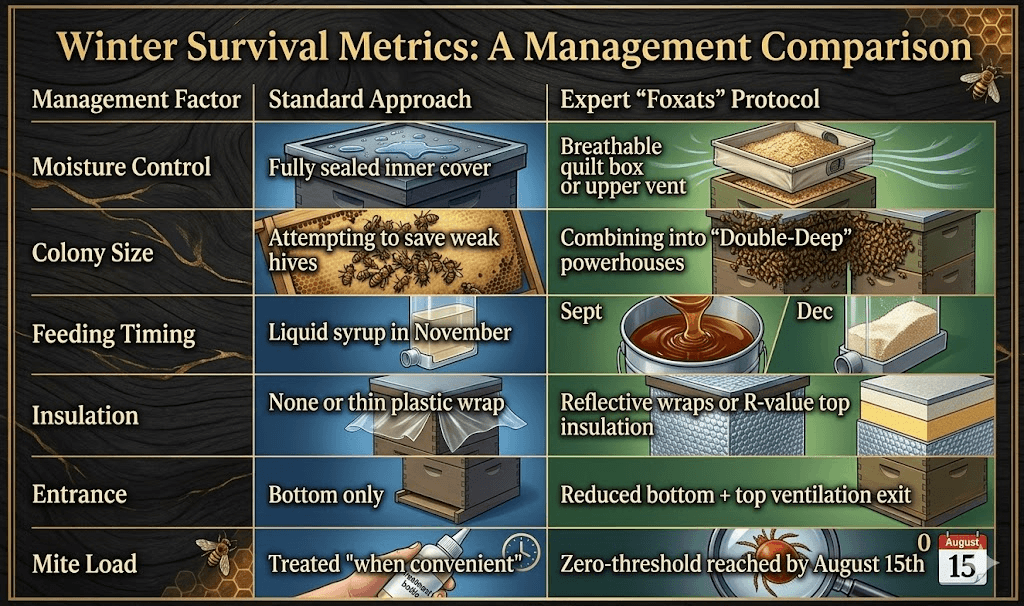
The efficiency of this cluster is entirely dependent on its size and the health of the individual bees. A small cluster has a higher surface-area-to-volume ratio, meaning it loses heat much faster than a large, robust colony. This is why “equalizing” hives in the autumn—combining weak colonies instead of trying to baby them through the frost—is a hallmark of expert management. A single large cluster will consume less honey per bee than two small ones, simply because of the laws of thermodynamics.
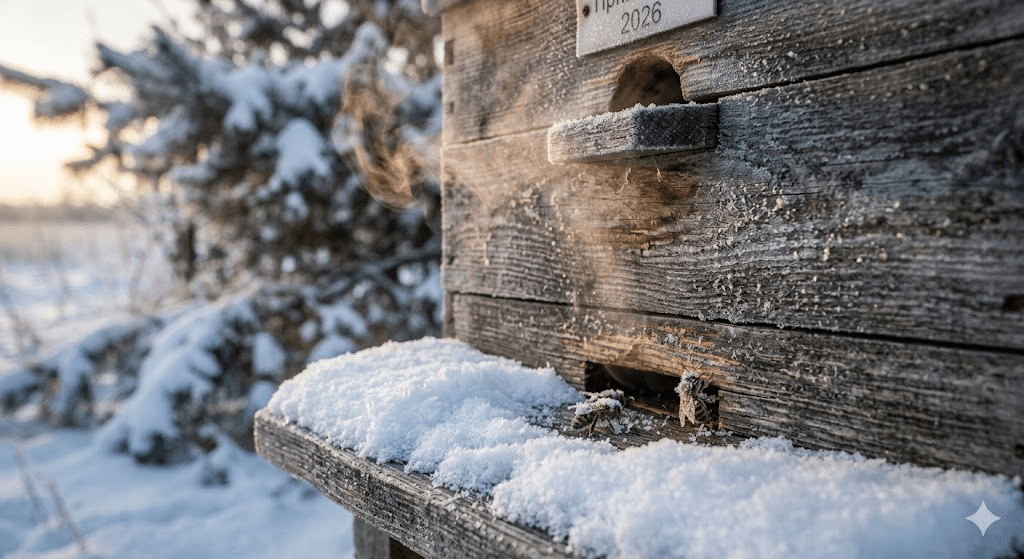
The Condensation Paradox: Why Ventilation is Vital
The greatest threat to a wintering colony is not the cold air, but the moisture generated by the bees’ own metabolism. For every pound of honey consumed, the bees produce roughly an equal amount of water vapor. In an uninsulated or poorly ventilated hive, this warm, moist air rises to the inner cover, hits the cold surface, and turns into ice-cold water droplets. When these droplets fall back onto the cluster, it causes “conductive cooling,” which can kill a colony within hours.
Mastering the “Winter Chimney Effect” is essential. The goal is to allow moisture to escape through a top entrance or an absorbent “quilt box” without creating a draft that strips the cluster of its hard-earned heat. Some professional managers utilize “moisture traps” or slanted inner covers to ensure that any condensation runs down the side walls of the hive rather than dripping onto the bees. It is a delicate balance of fluid dynamics that separates the master from the novice.
The Physiology of the “Winter Bee”: Beyond the Forager
A common misconception is that winter bees are simply regular foragers that happen to live longer. In reality, they are a distinct biological caste known as “diutinus” bees. Raised in late summer and autumn, these bees possess massively developed fat bodies rich in vitellogenin—a multifunctional protein that serves as a nutrient reserve and boosts the immune system.
If a colony is stressed by Varroa mites or poor nutrition during the “production” of these winter bees in August and September, the bees will lack the biological reserves to survive until spring. At Foxats, we emphasize that winter management begins in the heat of August. Ensuring high-protein pollen availability and near-zero mite counts during this window is the only way to guarantee a workforce that can endure 200 days without a flight.
Carbohydrate Placement and the “Bridge of Life”
Starvation in winter often occurs not because the hive is empty, but because the bees lose contact with their food. This “isolation starvation” happens when a cluster becomes trapped in a cold snap and cannot move even a few inches to the next frame of honey. The vertical movement of the cluster is natural; they move upward as they consume stores.
The expert beekeeper ensures “vertical continuity.” This means placing heavy frames of capped honey directly above the cluster in late autumn. If there is a gap of empty comb between the bees and their food, it acts as a thermal barrier they may not be able to cross. Some practitioners utilize “mountain camp” feeding—placing dry granulated sugar on top of the frames—as both an emergency food source and a moisture-wicking agent. It serves as a safety net, a “bridge of life” that ensures the cluster never loses access to the fuel it needs to keep the engine running.
Structural Integrity and Predator Defense
While the bees manage the internal environment, the beekeeper must secure the external perimeter. Winter is a season of desperation for local wildlife. Field mice see the warm, honey-filled hive as the ultimate winter apartment. If a mouse enters the hive, it destroys comb and creates a level of stress that can cause the cluster to break, leading to its death.
The installation of a “mouse guard”—a metal mesh that allows bees to pass but blocks rodents—is a non-negotiable step in late autumn. Furthermore, ensuring the hive is tilted slightly forward prevents meltwater from running into the entrance. These mechanical details, though simple, are the final pieces of the survival puzzle. A hive that is biologically strong but structurally vulnerable to predators or flooding is a failure of management.
The Bio-Acoustics of Winter: Listening to the Language of Survival
One of the most profound skills a master beekeeper develops is the ability to “inspect” a hive without ever cracking the propolis seal. In the dead of winter, opening a hive is a violent act that shatters the delicate thermal envelope. Instead, we rely on bio-acoustics. By using a simple stethoscope or a digital acoustic sensor against the hive wall, we can monitor the health of the cluster through its frequency profile.
A healthy, queen-right cluster produces a steady, low-frequency “hum” that represents the synchronized vibration of thousands of thoracic muscles. This sound is rhythmic and calm. However, a sharp, high-pitched “hiss” that slowly fades after a light tap on the box is a classic distress signal, often indicating the colony has lost its queen or is facing acute moisture stress. Understanding these acoustic signatures allows for non-invasive monitoring, ensuring the cluster remains undisturbed while giving the manager the data needed to decide if emergency intervention—such as supplemental dry feeding—is required. It is a transition from visual beekeeping to a sensory, data-driven methodology.
The Vitellogenin Pivot: The Biochemical Foundation of Spring
While most beekeepers focus on the volume of honey stores, the elite manager focuses on the internal protein reserves of the bees themselves. The transition from summer foragers to winter “diutinus” bees is driven by a massive accumulation of vitellogenin—a high-density lipoprotein stored in the fat bodies. This isn’t just a food reserve; it is the biological “battery” that will power the first round of brood rearing in February, long before the first pollen is available in the field.
The pivot occurs in late August and September. If there is a natural pollen dearth during this window, the bees will lack the necessary amino acids to build these fat bodies, regardless of how much sugar syrup they are fed. A colony with 100 pounds of honey but “protein-thin” bees will almost certainly fail or dwindle by March. This is why we implement a “Protein First” autumn protocol, providing high-quality pollen supplements during the rearing of the winter generation. We aren’t just feeding the bees for today; we are pre-loading the colony’s immune system and reproductive engine for the following spring. This biochemical preparation is the hidden “engine room” of successful overwintering.
We worked on this job for a long time The Bio-Security Protocol: A Masterclass in Preventing American Foulbrood (AFB)