In the intricate social structure of the honeybee, the queen is far more than a reproductive engine. She is the biological architect, the genetic blueprint, and the pheromonal anchor of the entire colony. Every trait expressed by the workforce—from their foraging range and winter hardiness to their temperament and resistance to pathogens—is a direct reflection of her DNA and the diverse genetics of the drones she mated with. For the professional beekeeper, the ability to assess, select, and manage queen quality is the ultimate skill that determines the economic and biological success of the apiary.
Understanding the difference between a high-functioning queen and a mediocre one requires a shift from superficial observation to deep biological analysis. A queen’s value is not measured by her age alone, but by her “fecundity potential” and the genetic diversity stored within her spermatheca.
The Biology of Larval Age and Royal Development
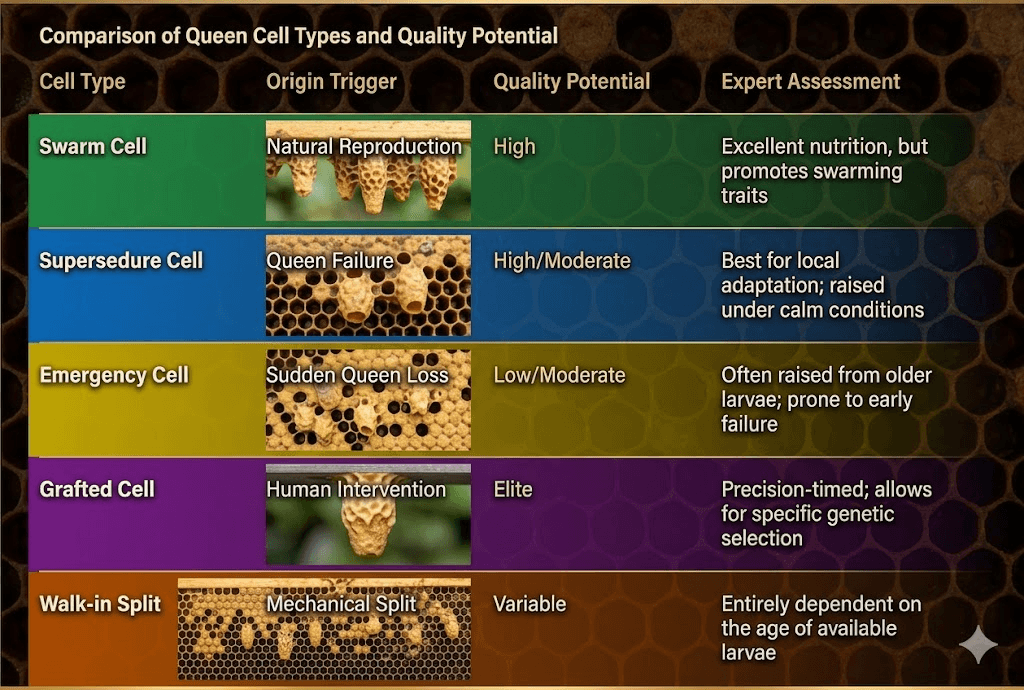
The quality of a queen begins the moment a tiny larva is selected for royal development. In the “teacher’s” view of apiculture, precision is everything. A worker larva and a queen larva are genetically identical; their divergent paths are dictated entirely by nutrition and the size of the cell. However, there is a critical “window of opportunity” that many novice beekeepers overlook.
Larvae grafted at six to twelve hours of age produce queens with significantly more ovarioles than those grafted at twenty-four hours or older. When a colony is forced to raise an “emergency” queen from older larvae, the resulting monarch is often a hybrid—physically smaller, with a shorter lifespan and a reduced pheromonal output. These “emergency” queens are the primary cause of early supersedure and winter failure. At Foxats, we prioritize queens raised through controlled grafting or natural supersedure under optimal nutritional conditions, ensuring that every architect of the hive is built for longevity and performance.
Pheromonal Harmony and Colony Cohesion
A superior queen maintains order through a complex chemical language known as “Queen Mandibular Pheromone” (QMP). This substance does more than just suppress the reproductive urges of the workers; it acts as a biological glue that keeps the colony focused and calm. A queen with high QMP output fosters a hive that is less prone to swarming and more resilient during nectar dirthes.
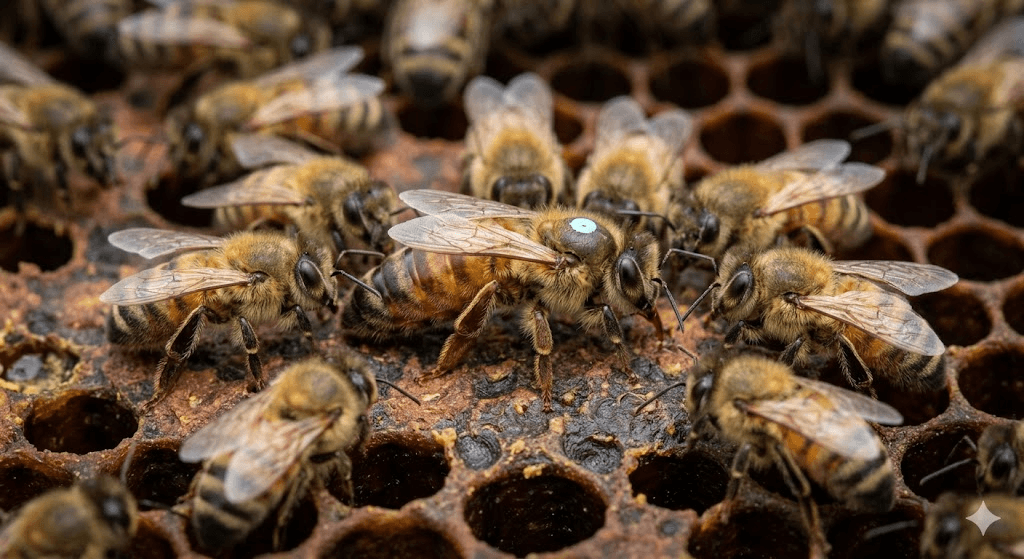
Observation of the “queen retinue”—the circle of workers surrounding and grooming the queen—is a vital diagnostic tool for the beekeeper. In an elite colony, the retinue is large, active, and attentive. If the workers are ignoring the queen or if she is moving erratically across the frame without a proper guard, it is a clear signal of pheromonal decline. Identifying these subtle behavioral cues allows the expert manager to intervene and re-queen before the colony’s productivity collapses.
The Mathematics of Mating: Drone Congregation and Diversity
The most misunderstood aspect of queen quality is the mating process. A queen does not mate with one drone; she ideally mates with fifteen to twenty-five different drones in a specific “drone congregation area.” This genetic diversity is the secret to a hive’s immune system. Research has shown that colonies with high “patriline” diversity (offspring from many different drones) are significantly better at regulating hive temperature and resisting diseases like Chalkbrood and Varroa.
The challenge for the stationary beekeeper is the quality of the local drone pool. If your neighbors are keeping neglected, mite-infested hives, your newly raised queens will mate with “weak” genetics. Mastery of the apiary involves “flooding” the area with high-quality drones from your best-performing, most hygienic hives. By managing the male side of the equation, you ensure that your queens return from their mating flights with a library of robust, resilient DNA.
Assessing the Brood Pattern: The Queen’s Transcript
If the queen is the architect, the brood nest is her transcript. A “solid” brood pattern—where nearly every cell in a concentrated area is filled with a healthy, convex capping—is the hallmark of a high-quality queen with excellent genetic compatibility. Conversely, a “shotgun” pattern, where empty cells are scattered throughout the brood, is often a sign of inbreeding or a lack of viable sperm.
This empty-cell phenomenon, often called “diploid drones,” occurs when the queen and the drones she mated with share similar alleles at the sex-determining locus. The workers identify these larvae as “incorrect” and consume them shortly after they hatch. This represents a massive waste of colony energy and protein. At Foxats, we emphasize that a spotty brood pattern is not just a cosmetic issue; it is a structural failure that requires immediate genetic replacement to save the season.
The Ethical Timing of Re-queening
One of the most difficult decisions for a beekeeper is when to replace a failing queen. There is a natural tendency to want to “give her one more chance,” but in professional hive management, sentimentality is the enemy of sustainability. A queen that shows signs of failure in the spring—spotty brood, reduced population, or drones in worker cells—will never recover to produce a surplus honey crop.
The expert protocol involves a proactive “re-queening cycle.” In intensive management systems, queens are often replaced every two seasons to maintain peak pheromonal output and egg-laying capacity. However, if a queen demonstrates exceptional hygienic behavior and high productivity, she may be kept longer as a “breeder queen.” The goal is a balance: maintaining the youthful vigor of the apiary while preserving the elite genetics that have proven their worth against the elements.
The Biochemical Blueprint of Royal Jelly and Larval Potential
The quality of a future queen is determined not merely by the size of her cell, but by the biochemical complexity of the royal jelly provided by the nurse bees. This substance is a product of natural alchemy, where specific concentrations of fatty acids, such as 10-HDA, and unique proteins like royalactin dictate the rate of the larva’s ovarian development. A professional approach requires an understanding that the health of the “starter” or “finisher” colony is a critical variable. If nurse bees are experiencing a protein deficit or environmental stress, the nutritional density of their glandular secretions drops. The result is a queen that may appear physically perfect but possesses a limited biological reserve that will be exhausted prematurely. True selection begins with the preparation of an ideal “incubator”—a colony overflowing with young, well-fed nurse bees and an abundance of fresh, high-quality pollen.
Epigenetic Resilience and Environmental Imprinting
There is a subtle, often overlooked correlation between the environmental conditions during a queen’s development and her future performance, a phenomenon known as epigenetic imprinting. Temperature stability within the brood nest during the royal development phase must be flawless. Even a brief chilling of the queen larva during periods of intense cellular division can lead to latent metabolic defects. Experienced queen breeders know that queens raised during a stable, warm nectar flow possess superior vitality compared to those raised during volatile weather shifts. This is because the environment “toggles” specific genetic switches related to stress adaptation and longevity. These epigenetic factors determine how the colony will eventually react to seasonal shifts or forage scarcity, making the environment a silent partner in the queen’s genetic expression.
Strategic Drone Saturation and Airspace Management
Most failures in genetic selection occur due to a lack of focus on the paternal line. While a queen mates in general drone congregation areas, the master beekeeper can and should influence this process through a strategy of “drone saturation.” This involves the deliberate cultivation of massive drone populations within the strongest, most productive, and gentlest colonies in the apiary. By creating a powerful genetic “flood” around the mating yard, we significantly increase the probability that the young queen will encounter drones that carry the desired traits: winter hardiness, disease resistance, and docility. This is not just biology; it is the active management of the local airspace, where every flight represents a potential upgrade or downgrade for the future of the entire operation.
The Pheromonal Synthesis of Queen Introduction
The process of introducing a new queen is a collision between two distinct pheromonal worlds. Often, the cause of a failed introduction is not the quality of the queen, but a mismatch between the colony’s “expectations” and the queen’s current biological state. If a queen has been shipped via mail, she is often in a state of high stress, which temporarily suppresses her pheromonal output. The colony may perceive this chemical drop as a sign of a defective queen and immediately trigger a supersedure impulse. Mastery of hive management involves giving the queen a “recovery period” to restore her chemical status before her full release into the brood nest. Understanding these micro-biological signals prevents the loss of elite genetics and ensures a seamless integration of the new “architect,” guaranteeing colony harmony and rapid expansion from day one.