Introduction: The Hidden Hunger of the Honeybee
In my 15 years as an agronomist, I have seen many beekeepers focus exclusively on honey yields (carbohydrates) while completely overlooking the foundation of the hive’s immune system: Protein. Just as a crop cannot thrive without a balanced Nitrogen ($N$) supply, a honeybee colony cannot survive the winter without a specific array of essential amino acids.
This article explores the bio-chemical requirements of larval nutrition and how professional apiarists can use agronomic data to prevent “pollen stress” before it collapses a colony.
Part I: The Vitellogenin Factor – The Hive’s Biological Battery
At the center of bee health is a glycolipoprotein called Vitellogenin. Think of it as the colony’s “health currency.”
- Function: Vitellogenin is stored in the fat bodies of nurse bees. It is the precursor to royal jelly and acts as a potent antioxidant, extending the lifespan of “winter bees” from weeks to months.
- The Connection: The production of Vitellogenin is strictly dependent on the availability of high-quality pollen. If the pollen available in your local forage area is deficient in even one essential amino acid, the production of this vital protein drops, leading to premature aging and hive collapse.
Part II: Analyzing Amino Acid Profiles – Not All Pollen is Equal
From a botanical perspective, nectar is the “fuel,” but pollen is the “raw material” for building bee bodies. As an agronomist, I categorize forage not just by flowering dates, but by the Biochemical Quality of the pollen.
The “Essential 10” Amino Acids
Bees require ten essential amino acids that they cannot synthesize themselves. The most critical for brood development include:
- Leucine & Isoleucine: Essential for the growth of thoracic muscles in foragers.
- Valine: Key for the development of the nervous system.
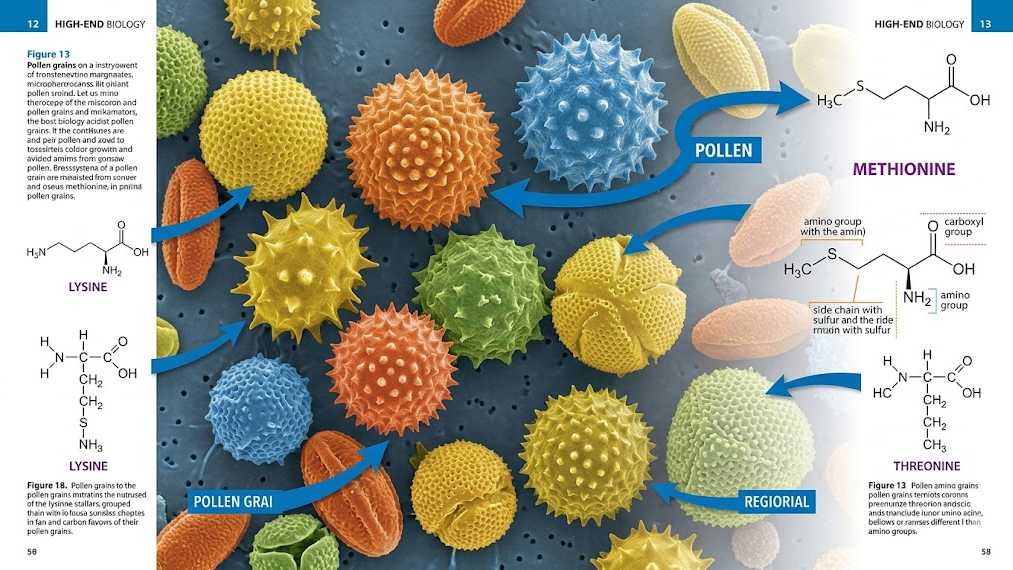
- Methionine: Often the “limiting factor” in many pollens (especially sunflower), Methionine is crucial for metabolic regulation.
Expert Data: Pollen from Willow (Salix) and Fruit Trees (Rosaceae) typically holds a protein content of 25-30%, whereas Pine or Sunflower pollen can drop as low as 12-15%. This is why a colony can “starve” in the middle of a sunflower field despite having tons of nectar.
Part III: The “Brix” of Nectar and Foraging Efficiency
We often measure soil health using a Refractometer to check the Brix levels (sugar content) of plant sap. We must apply the same precision to the apiary.
3.1 The Energy Cost of Foraging
If a flower produces nectar with only 15% sugar, the bee must spend more energy flying and evaporating the water than it gains from the sugar itself. High-quality agronomic management of the landscape ensures that plants produce nectar at 35-50% Brix, significantly reducing the “metabolic tax” on your foragers.
Part IV: Managing the “Summer Dearth” – A Proactive Approach
In many regions, including Ukraine and parts of the USA, there is a period in late July where nothing flows. This is the “danger zone” for winter preparation.
4.1 The Agronomic Intervention
To bridge this gap, we recommend planting Niche Forage that thrives in high-heat, low-moisture conditions:
- Buckwheat ($Fagopyrum \ esculentum$): Excellent for quick phosphorus cycling and high-volume nectar.
- Phacelia: The “Queen of Pollen,” providing a massive boost of Methionine and Lysine right when the winter bees are being raised.
Part V: Digital Monitoring for Nutritional Stress (Pro Tools)
In the Foxats Pro Tools philosophy, we don’t guess—we measure. By using internal hive scales, we can track the “Pollen Income” of a colony.
The Logic:
If the hive weight is stagnant but the brood area is expanding, the bees are consuming their internal protein reserves. This is the trigger for the professional beekeeper to provide Fermented Pollen Supplements to ensure the winter cluster remains “protein-positive.”
Conclusion: Engineering Resilience
The future of beekeeping is not found in the smoker or the veil; it is found in the laboratory and the soil map. By understanding the amino acid requirements of our bees and the agronomic potential of our land, we create a resilient system that can withstand the pressures of modern agriculture.
| Plant Species | Protein Content (%) | Primary Amino Acid Limitation | Agronomic Soil Requirement |
| Salix (Willow) | 28-32% | Low | High Moisture / High Nitrogen |
| Rosaceae (Fruit) | 24-26% | Balanced | High Potassium ($K$) |
| Helianthus (Sunflower) | 12-15% | Methionine & Iso-leucine | High Boron / Phosphorus ($P$) |
| Phacelia | 22-25% | None (High Lysine) | Neutral pH |
Part VI: Micronutrients as Catalysts for Pollen Synthesis
As an agronomist, I often observe that even with adequate Nitrogen, plants fail to produce high-quality pollen if the trace mineral balance is off. In the context of “Precision Apiculture,” we must look at Micronutrients not just as plant food, but as precursors to bee health.
6.1 The Boron ($B$) and Zinc ($Zn$) Connection
Boron is essential for pollen tube elongation and sugar transport within the plant. From my research, soils deficient in Boron produce “sterile” or “nutrient-void” pollen.
- Zinc ($Zn$): Acts as a structural component for many enzymes. For bees, Zinc-rich pollen supports the development of the hypopharyngeal glands, which are responsible for producing royal jelly.
- Manganese ($Mn$): Crucial for the oxygen-evolving complex in photosynthesis. A plant under Manganese stress will produce less nectar and lower concentrations of essential oils in its pollen, making it less attractive to foragers.
6.2 The Agronomic Solution: Soil Testing
I recommend that commercial beekeepers partner with local farmers to perform Leaf Tissue Analysis or Soil Testing. By applying targeted foliar fertilizers to honey-producing crops, we can bio-fortify the pollen at the source, ensuring our bees receive a “multivitamin” directly from the flower.
Part VII: The $CO_2$ Paradox – Climate Impact on Protein Density
We are currently facing a phenomenon known as “Nutritional Dilution.” As atmospheric $CO_2$ levels rise, plants grow faster and larger, but their protein-to-carbohydrate ratio drops.
7.1 Rising $CO_2$ and the Goldenrod Case Study
Research indicates that the protein content of Goldenrod (Solidago)—a critical late-season forage for winter preparation—has decreased by nearly 30% since the industrial revolution.
For the professional beekeeper, this means that even if the fields look yellow and productive, the bees might still be suffering from “hidden hunger.”
What this means for the Foxats methodology:
We must compensate for this atmospheric shift by ensuring our colonies have access to high-diversity forage. Monoculture landscapes are increasingly dangerous in a high-$CO_2$ world because they offer no “biochemical backup” when the primary crop’s protein quality fails.
Part VIII: Advanced Fermentation – Bio-Available Protein Supplements
When natural pollen is unavailable or low-quality, we turn to Pro Tools and bio-engineering. Simply providing dry soy flour is an outdated and inefficient method.
8.1 The Lactic Acid Fermentation (LAF) Process
In nature, bees do not eat raw pollen; they eat Bee Bread. They preserve pollen through lactic acid fermentation, which breaks down the tough cellulose “exine” shell of the pollen grain.
- Bio-Availability: Fermentation increases the solubility of proteins, making amino acids like Lysine and Tryptophan much easier for the nurse bees to absorb.
- The Foxats Protocol: We advocate for “pre-fermented” protein patties. By using specific strains of Lactobacillus, we can mimic the natural bee bread process in a controlled laboratory environment, providing a supplement that is 40% more digestible than standard dry substitutes.