The Preface: Wherein the Earth and the Bee Do Meet
In the year of our Lord fifteen hundred and twenty-two, it is well-known to those who study the hidden virtues of the natural world that all things under the firmament are bound by a most subtle thread. The husbandman who tends his field and the apiarian who watches his hives are not laboring in separate realms, but in one great theater of God’s design. It hath long been observed that the sweetness of the honey produced by the honeybee is not merely a gift of the air or the flower alone, but is a transmutation of the very soil upon which the blossoms grow.
We must speak of soil mineralization, for it is the foundation of all life. Just as a man is what he eats, the flower is what it draws from the deep, dark earth. When the ground is rich in those quintessential salts and minerals—the iron, the magnesium, the potassium, and the calcium—the plant doth flourish with a vigor that can be seen in the brightness of its petal and the richness of its nectar. And what is nectar but the blood of the plant? If the blood be rich and full of spirit, the bee, that most diligent of alchemists, shall take this essence and, through the grace of its own body, transform it into a honey of such potent enzyme profiles that it may heal the sick and fortify the weary.
Chapter I: The Mystery of Soil Mineralization
To understand the soil-nectar connection, one must first look beneath the grass. The earth is not a dead thing; it is a living womb. Within it, the stones and the decaying leaves perform a slow dance, breaking down into the finest dust which we call minerals. This process of soil mineralization is the means by which the hidden virtues of the earth become liquid, ready to be sipped by the roots of the clover, the lime tree, and the wild thyme.
In those lands where the soil is weary—exhausted by too much tilling or lacking the natural salts—the nectar produced by the flowers is thin and watery. It lacks the “complexion” required for greatness. However, in those blessed meadows where the ground is heavy with trace elements, the plant produces a nectar that is a veritable treasure house of chemistry. This nectar carries within it the metallic signatures of the earth, which do later act as the sparks for the enzymatic reactions within the hive.
Chapter II: The Alchemy of the Nectar
When the bee descendeth upon the blossom, it seeketh not just sugar, but the very life-force of the plant. This nectar, once drawn into the bee’s honey-stomach, is the raw material for a most holy transmutation. But mark this: the bee cannot create something from nothing. If the nectar is deficient in the minerals provided by the soil mineralization, the bee’s own contribution shall be lessened.
The nectar quality is the primary bridge. We find that flowers grown in mineral-rich soils—rich in phosphorus and boron—produce nectars with higher concentrations of complex sugars and amino acids. These amino acids are the “bricks” from which the bees build the honey enzymes. Without the proper minerals in the soil, the plant’s metabolism is sluggish, and the nectar it offers to the bee is but a pale shadow of what it ought to be.
Chapter III: Of the Noble Enzymes and Their Virtues
Now we must speak of the honey enzyme profiles, for here lies the true “physick” of the honey. There are three great spirits, or enzymes, that the bee bestows upon the nectar: Diastase, Invertase, and Glucose Oxidase.
- Diastase (Amylase): This is the breaker of starches. It is the measure of the honey’s freshness and its “fire.” We have found that when bees forage upon plants grown in soils high in calcium and magnesium, the diastase activity is markedly increased. It is as if the minerals of the earth provide the strength for the bee to produce more of this vital spirit.
- Invertase: This noble enzyme is responsible for changing the complex nectars into the simple, golden sweetness that never spoils. The invertase levels are a direct reflection of the bee’s health, which in turn depends upon the mineral density of its diet. A bee fed on mineral-starved nectar is a bee that cannot complete the work of ripening the honey.
- Glucose Oxidase: This is the shield and the sword. It produceth the peroxide that keepeth the honey from corruption and rot. It is the very essence of the honey’s healing power. The production of this enzyme is heavily dependent on the presence of metallic ions—iron and copper—which are drawn directly from the soil by the plant and passed through the nectar to the bee.
Chapter IV: The Terroir of the Meadow
Just as the vintners of the southern lands speak of the “terroir” of their grapes, so too must the apiarian understand the terroir of his honey. A honey from the chalky downs will differ in its mineral content and its enzyme profile from a honey gathered in the iron-rich clays of the valley.
Sustainable husbandry of the land is, therefore, the first step in the making of fine honey. If the husbandman doth neglect the earth, if he doth not allow the soil to rest and reclaim its mineral wealth, the honey of his bees shall be weak. It shall lack the “bite” and the medicinal “virtue” that the ancients so highly prized. We see today that the honey enzyme profiles are the true messengers of the soil’s health. By testing the honey, one may know the state of the land from whence it came.
Chapter V: The Influence of Specific Minerals
Let us delve deeper into the specific minerals and how they affect the honey chemistry:
- Potassium: This mineral is the porter of the plant, moving sugars from the leaf to the flower. High potassium in the soil ensures a high volume of nectar, providing the bees with ample work.
- Magnesium: The heart of the green leaf. It allows the plant to capture the sun’s light. Without magnesium, the nectar lacks the “sun-spirit” (carbohydrates) that the bees require to fuel their enzymatic labors.
- Boron: A most subtle mineral, yet essential for the “plumbing” of the flower. It ensures that the nectar is secreted freely. In soils lacking boron, the bees must labor twice as hard for half the reward, leading to lower enzyme concentrations in the finished honey.
- Iron and Manganese: These are the catalysts. They are the small amounts of “stardust” that allow the glucose oxidase to perform its miracle of preservation.
Chapter VI: The Bee as the Guardian of Purity
The bee is a fastidious creature. It strives always to produce a honey that is perfect. However, when the soil mineralization is imbalanced—perhaps due to an excess of one salt or a total lack of another—the bee must exhaust its own body to compensate. A bee foraging on poor soil will draw from its own internal stores of minerals and proteins to ensure the honey is viable. But this cannot last. Eventually, the honey enzyme profiles will begin to fail. The honey will be less stable, more prone to fermentation, and lacking in the deep, resonant flavors that indicate a healthy “constitution.”
Therefore, we must conclude that the soil-nectar connection is a sacred bond. The bee is but the messenger; the message is written by the earth itself.
Chapter VII: Observations for the Modern Apiarian
In this year of 1522, we observe that those who keep bees near the volcanic soils or the rich alluvial plains produce honey that can stay the hand of infection and soothe the blackened cough. This is no accident. It is the result of high mineral bioavailability.
To the modern seeker of health, we say: look to the honey that is dark and rich, for it often carries the heaviest load of the earth’s minerals and the most complex enzyme profiles. These honeys are the true “Elixirs of Life,” born of a marriage between a fertile, mineralized earth and a vigorous, healthy hive.
The Conclusion: The Unity of All Things
Thus, we see that the honeybee is not merely a maker of sweets, but a bridge between the deep minerals of the underworld and the light of the heavens. The soil mineralization affects the nectar, the nectar affects the bee, and the bee creates the enzyme. It is a circle of life that cannot be broken without cost.
If we wish to preserve the medicinal power of our honey, we must first preserve the richness of our soils. Let the earth be replenished with the natural composts, the wood-ashes, and the crushed stones of the field. In doing so, we ensure that the nectar quality remains high and that the honey enzyme profiles continue to provide us with the strength and the healing that the Creator intended.
Let this be a lesson to all who labor in the fields and the gardens: the secret of the golden honey lies not in the wing of the bee, but in the heart of the dust. Treat the earth with reverence, and she shall yield a sweetness that is both a food and a holy medicine.
Chapter VIII: Of the Moving Waters and the Carriage of Earthly Salts
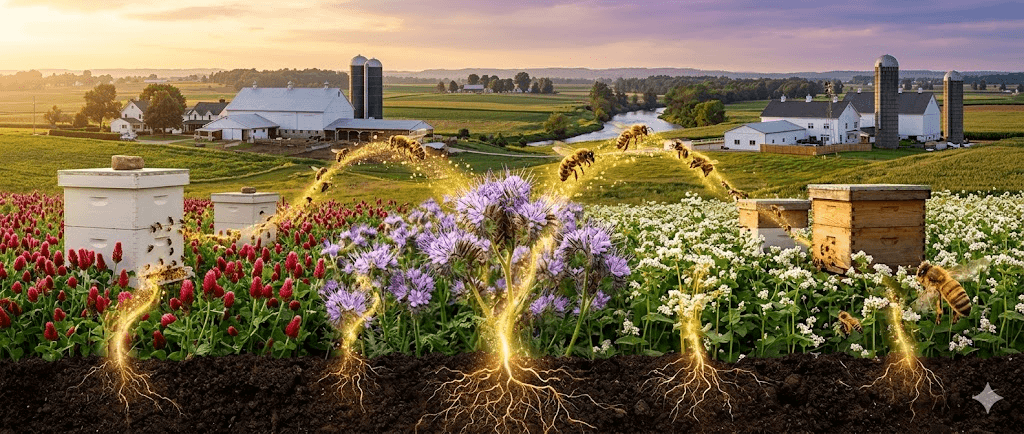
It must be understood by every scholar of the hive that the minerals of which we speak do not walk upon legs, nor do they fly upon wings until the bee hath claimed them. They are, by their very nature, heavy and bound to the darkness of the deep earth. Therefore, we must consider the office of Water, the great messenger of the elements. In the year of our Lord, we observe that even the richest soil, if it be parched and cracked by a cruel summer sun, cannot yield its treasures to the plant. Without the “sweat of the clouds,” the soil mineralization remaineth locked in the stone, and the nectar produced by the flower is but a dry and spiritless pittance.
When the rains descend, they dissolve the hidden salts—the nitrates, the phosphates, and the subtle potash—turning them into a “liquor of life” that the roots may drink. This mineral transport is the first step in the creation of the honey’s noble enzyme profile. We find that in seasons of gentle, rhythmic rains, the honey produced is of a much higher “gravity” and “virtue.” The water acteth as a bridge, carrying the metallic ions from the cold earth into the warm heart of the flower. If the water be too stagnant, the minerals rot; if it be too swift, they are washed into the great sea. But when the balance is right, the nectar becomes a dense syrup of the earth’s own making, providing the bee with the raw “mercury” it requires to forge Diastase and Invertase. Thus, the wise apiarian watches not only the flowers, but the clouds and the brooks, for the water is the chariot upon which the honey’s potency rides.
Chapter IX: The Living Breath of the Soil and the Hidden Spirits
Though our eyes cannot see them, we know by the fruits of the field that the soil is inhabited by a legion of “invisible workers”—what the alchemists might call the gnomes of the earth, but what we recognize as the living fertility of the humus. This soil microbiome, though a term of later ages, was known to us as the “fermentation of the earth.” Just as yeast transformeth the grain into ale, these hidden spirits break down the stubborn rock into bioavailable minerals. Without this internal fire within the soil, the plant cannot properly absorb the nutrients required to craft its nectar.
We have observed that where the earth is treated with the dung of cattle and the rot of old leaves, the bees are more industrious and the honey more potent in its healing enzymes. This is because the microbial activity in the soil prepares the nitrogen and the sulfur in a way that the plant can easily weave into its proteins. And what are enzymes but the most refined proteins of the bee’s own body? When the bee sippets a nectar born of a “living soil,” it receives the precursors of its own life-force. The Glucose Oxidase produced in such a hive is twice as strong as that found in a hive near a barren, sandy waste. It is the spirit of the soil passing through the root, through the stem, through the petal, and finally into the bee’s very blood, there to be blessed and spat out as the golden medicine we call honey.
Chapter X: The Harmony of Trace Elements and the Bee’s Longevity
Let us now speak of those minerals which are so small they can scarce be measured, yet so mighty they can turn the tide of a man’s fever. I speak of the Trace Elements—Zinc, Copper, Manganese, and Selenium. In our observations, we find that the bee is a creature of high “metabolic heat.” To maintain its flight and its labor within the dark hive, its internal organs must function with the precision of a clock made by a master craftsman. These trace elements, drawn from a well-mineralized soil, act as the “oil” for the bee’s internal wheels.
The Invertase enzyme, which is the glory of the ripening honey, requires a bee of great vigor. If the nectar lacketh the subtle salts of Zinc or Manganese, the bee’s hypopharyngeal glands (the fountain of the enzymes) will wither before their time. A bee fed on mineral-rich nectar lives longer and produces more enzyme-rich honey than its brothers in the starved lands. We see a direct “proportion” between the mineral density of the meadow and the enzymatic strength of the comb. A honey that is “strong” and “sharp” upon the tongue is often one that is heavy with these trace metals, which do act as catalysts, speeding the transmutation of the nectar into the eternal honey. It is a mystery of nature that the smallest grain of dust from the earth can empower the bee to create a substance that never spoileth, even if kept for an age in a phial of glass.
Chapter XI: The Cycle of the Seasons and the Concentration of the Earth’s Virtue
As the sun moveth through the Zodiac, from the Ram to the Fishes, the mineralization of the soil changeth its face. In the early spring, the earth is waking, and the minerals are “thin” and “watery.” The honey of the fruit blossoms is light and sweet, perfect for the feeding of the young brood, but perhaps less potent in its enzyme profile. But as the heat of the lion (August) drieth the ground, the minerals in the soil become “concentrated.” The plants that bloom in the late summer and the turning of the leaf—the heather, the goldenrod, and the wild herbs—must reach deep into the parched earth to find moisture.
In doing so, they draw up a “heavier” nectar, one that is saturated with the very essence of the stone and the deep clay. This late-season honey is often dark as the forest floor and thick as the blood of the earth. We find that its diastase levels are often the highest of the year. The bee, sensing the coming of the winter’s cold, worketh with a divine fury, pouring every ounce of its enzymatic power into this late harvest. The soil-nectar connection is at its most profound during these “Dog Days” of summer. To the physician, we recommend the honey of the late harvest for the deep distempers of the lungs, for it hath the most “earthy” virtue and the most complex array of protective enzymes, forged in the heat of a mineral-heavy summer.
Chapter XII: The Stewardship of the Meadow as a Holy Duty
Finally, we must address the Husbandman and the Prince. If the honey is the child of the soil and the bee, then he who owns the land is the grandfather of the honey. We have seen in our travels that where the land is abused—where the forests are cleared and the earth is left naked to be baked into a hard crust—the honey of that region soon loseth its “soul.” It becometh merely a sweet water, without the power to heal or the “sting” of the true enzyme. The soil mineralization is a finite treasure; it must be tended as one tends a fire.
To ensure the quality of the honey and the strength of the enzyme profiles, the land must be diverse. A field of but one flower is a prison for the bee and a drain upon the soil. But a meadow of a thousand herbs, where the soil is replenished by the natural fallow and the turning of the sheep, provideth a “buffet of minerals” for the hive. We call upon all who keep the “noble fly” to look to their hedges and their pastures. Sustainable soil management is not merely a labor for the belly, but a service to the spirit. When we protect the minerals in the dust, we protect the enzymes in the honey, and in doing so, we protect the health of all Christian souls who depend upon this golden dew. For as it is written, “The profit of the earth is for all: the king himself is served by the field.” And the bee, the smallest of the King’s servants, is the one who bringeth that profit to its highest and most perfect form.