Introduction: The Industrial Bottleneck
In the commercial beekeeping landscape of the United States, the honey house is often where profit margins are either secured or lost. For many operations, the extraction process remains a manual, labor-intensive bottleneck that limits the overall scale of the business. However, by applying the principles of Data Science and Industrial Automation, we can transform the honey house from a chaotic workshop into a high-precision processing facility. This article explores how Variable Frequency Drives (VFDs), automated uncapping, and Python-based performance tracking can optimize your throughput and preserve the biological integrity of your harvest.

Section 1: The Physics of Extraction – Viscosity, Velocity, and VFDs
As an agronomist, I view honey extraction as a problem of fluid dynamics. The efficiency of removing honey from the comb is dictated by its viscosity, which is a direct function of temperature and moisture content. If you spin a frame too slowly, honey remains in the cells; too fast, and you risk “blowing out” the delicate wax foundation, especially with fresh, high-moisture combs common in the American spring flow.
The solution is the implementation of Variable Frequency Drives (VFDs). A VFD allows the beekeeper to program a specific “Ramp-Up Profile.” Instead of a binary “On/Off” switch, the extractor starts at a low RPM to remove the bulk of the weight, then incrementally increases speed as the frame becomes lighter and more structurally stable. In our operation, we have mapped these profiles to specific honey types: a “Clover Profile” requires a faster ramp-up than a thick, high-viscosity “Late-Season Wildflower” batch.
Section 2: The Automation Stack – From Manual Labor to Systematic Flow
In the US, labor is one of the highest overhead costs. An automated extraction line allows a two-person team to process the same volume of honey that previously required five people. Our “Automation Stack” includes:
- Automated Uncapping Machines: Utilizing heated vibrating blades that ensure a precise depth of cut, reducing “wax crumbs” in the final product.
- Sequential Centrifugation: Extractors that automatically reverse the direction of rotation, ensuring both sides of the frame are cleared without manual flipping.
- Sumps with Level Sensors: Automated pumps that move honey from the extractor to the settling tanks based on ultrasonic level sensors, preventing overflows and ensuring a steady flow through the filtration system.
Section 3: Throughput Metrics – Analyzing the “Honey House ROI”
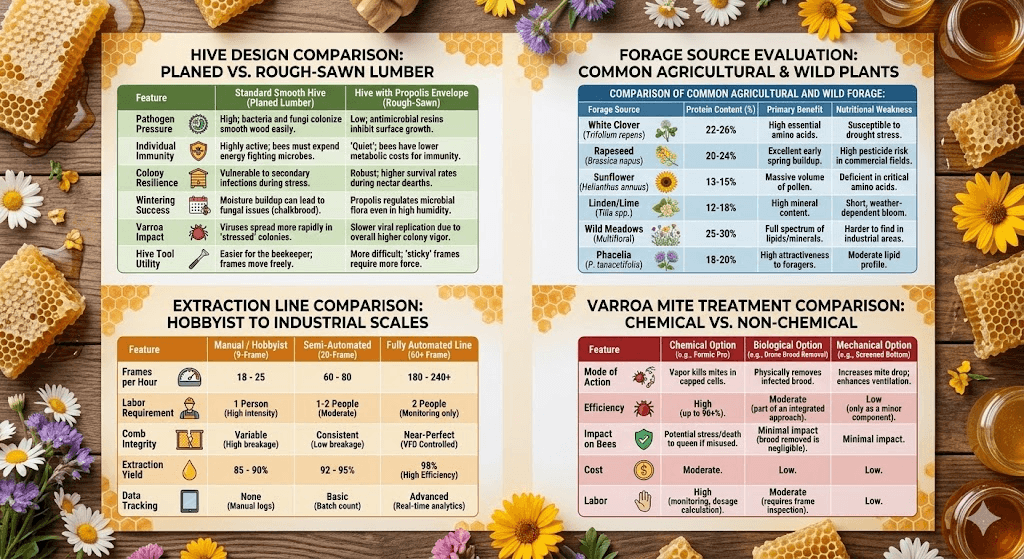
To justify the investment in automation, we must look at the hard data. The following table compares the efficiency of three different scales of operation common in North America:
Section 4: The Developer’s Advantage – Python-Based Performance Monitoring
As an automation developer, I don’t believe in “black box” machinery. I have integrated our extraction line with a Python-based monitoring dashboard. Using a Raspberry Pi connected to the motor controllers and flow meters, we track every batch in real-time.
The “Extraction Efficiency” Algorithm
My script correlates the “Weight of Supers In” vs. “Gallons of Honey Out.” If the ratio falls below the predicted threshold (calculated based on our previous refractometer data), the system flags a “Mechanical Inefficiency” alert. This allows us to identify if a motor belt is slipping or if an uncapper blade needs sharpening before it affects the day’s total output. By turning the extraction process into a stream of data, we can identify bottlenecks and optimize our “frames-per-man-hour” metric, ensuring maximum profitability during the short, high-pressure harvest season in the US.
Section 5: The Pedagogical Shift – Training Workers for the High-Tech Apiary
My 12 years of experience as a teacher have taught me that high-tech equipment is only as good as the people operating it. Transitioning to an automated honey house requires a shift in Training Methodology. We moved from teaching “how to uncapping a frame” to teaching “how to monitor a system.”
We utilize a “SOP (Standard Operating Procedure) Checklist” for every technician. Our training focuses on:
- Sensor Calibration: Ensuring the ultrasonic and temperature sensors are accurate to +/- 1%.
- VFD Programming: Understanding how to adjust the ramp speed based on the “feel” of the honey viscosity.
- Emergency Stops and Manual Overrides: Ensuring safety in a high-speed centrifugal environment. This pedagogical approach reduces equipment downtime and empowers the team to solve technical issues on the fly, a necessity when your harvest window is limited by the fast-moving American climate.
Section 6: Post-Extraction Hygiene and FSMA Compliance
In the United States, food safety is governed by the Food Safety Modernization Act (FSMA). Automation significantly simplifies compliance. Because our system is closed-loop and utilizes stainless steel components with “Clean-in-Place” (CIP) capabilities, the risk of external contamination is minimized.
Our Python script also handles “Batch Traceability.” Every bucket of honey is assigned a unique ID that links back to the specific apiary site, the date of extraction, and even the moisture level at the time of processing. In the event of a quality audit, we can provide a complete “Digital Paper Trail” in seconds. This level of transparency is what separates professional commercial operations from the rest of the market.
Conclusion: The Future is Automated
Optimizing the honey house is not just about buying faster machines; it is about integrating Agronomic knowledge, Automation technology, and Educational discipline into a single, cohesive system. By moving toward a data-driven extraction model, we reduce labor costs, increase yields, and ensure a level of quality and traceability that the modern American consumer demands. The honey house of the future is quiet, clean, and controlled by code.
The Hygroscopic Micro-Climate: Managing Atmospheric Vapor during Extraction
In the professional American honey house, the greatest invisible enemy isn’t mechanical failure—it is humidity. As an agronomist, I have spent years managing vapor pressure deficit (VPD) in agricultural settings, and the same physics apply with brutal efficiency during honey extraction. Honey is an incredibly hygroscopic substance; the moment it is removed from the comb and aerosolized by the centrifugal force of the extractor, its surface area increases exponentially. If the relative humidity (RH) in your extraction room is above 55%, your honey will act as a molecular sponge, absorbing water from the air.
To combat this, we have integrated our extraction automation with a specialized HVAC and Dehumidification Logic. Using a network of DHT22 sensors connected to a Python-based controller, we maintain the extraction room at a strict 35–40% RH. This is a critical “data-driven” step that many beekeepers overlook. If the sensors detect a spike in humidity (often caused by the arrival of “wet” supers from the field or a change in external weather), the system automatically ramps up the industrial dehumidifiers and throttles the intake fans. By managing the air as a component of the machinery, we ensure that the refractometer readings taken in the field match the final product in the barrel, preserving the “Grade A” density required for premium US contracts.
VFD Torque Analysis: Using Motor Amperage as a Proxy for Viscosity
As an automation developer, I look for “hidden data” within existing hardware. One of the most powerful metrics we utilize in our honey house is the Motor Torque and Amperage Feedback from our Variable Frequency Drives (VFDs). In fluid dynamics, viscosity is the primary resistance to flow. When we spin a 60-frame radial extractor, the amount of current required to maintain a specific RPM is a direct indicator of the honey’s thickness.
We have developed a Python script that pulls real-time amperage data from the VFD’s Modbus interface. If the motor is drawing significantly more current than the “baseline” for a specific RPM, the script recognizes that the honey is too cold or high in viscosity. Instead of allowing the extractor to fight the resistance—which risks breaking the wax combs or overheating the motor—the system automatically pauses the cycle and triggers a “Warming Sequence” or adjusts the ramp-up speed to a more conservative profile. This “Real-Time Viscosity Feedback” allows us to process diverse honey types, from the thin spring wildflower to the thick, resinous late-summer buckwheat, without manual intervention or equipment damage.
Centrifugal Wax Recovery and the Chemistry of Cappings Management
The extraction process doesn’t end when the honey leaves the comb; the management of “cappings” (the wax seals) is where many US operations lose a significant percentage of their profit. In my 15 years as an agronomist, I have applied the principles of Centrifugal Separation used in oilseed processing to our wax recovery system. We utilize a high-speed “Cappings Spinner” that is synchronized with the main extraction line.
The efficiency of wax recovery is a function of G-force and temperature. If the cappings are processed too cold, honey remains trapped in the “slumgum” (the waste byproduct). If they are too hot, the wax melts and darkens the honey. Our automated system utilizes infrared (IR) sensors to monitor the temperature of the cappings as they fall from the uncapper. The data determines the RPM of the spinner. By optimizing this “Secondary Extraction,” we achieve a recovery rate of nearly 99% of the honey trapped in the wax. Furthermore, the dry wax produced is of superior quality—clean, light in color, and ready for the high-value cosmetic market in the USA, turning what many consider a waste product into a secondary revenue stream.
The Digital Paper Trail: QR-Code Traceability and FSMA Compliance
In the modern United States regulatory environment, the Food Safety Modernization Act (FSMA) has made “traceability” a mandatory requirement for commercial food producers. For the beekeeper, this can be a nightmare of manual paperwork. However, by leveraging my background in social media management and digital property management, I have digitized the entire “Chain of Custody” for our honey harvest.
Every pallet of supers arriving from the field is assigned a unique QR Code. This code is scanned at the entrance of the honey house, automatically populating our database with the apiary site name, the date of removal, and the field moisture readings. As the supers move through the uncapper and into the extractor, the Python-based management system logs the extraction time, the average RPM of the cycle, and the final barrel ID.
This creates an immutable Digital Paper Trail. If a customer or an FDA inspector asks about a specific batch of honey, we don’t dig through filing cabinets; we scan a label on the barrel and instantly pull up a “Health and Processing Report” that details every step from the field to the bucket. This level of professionalism and data transparency is a powerful marketing tool when dealing with high-end retailers and international distributors who demand accountability in their supply chain.
Predictive Maintenance: The Vibration API and Mechanical Longevity
One of the most expensive events in a honey house is a mid-season mechanical failure. To prevent this, I have integrated a Vibrational Analysis API into our extraction line. We have placed small, low-cost accelerometers on the main bearings of our largest extractors and pumps. These sensors send high-frequency vibrational data to our central Python server.
By applying Fourier Transform algorithms, the script can distinguish between the normal “hum” of a balanced extractor and the specific “frequency signature” of a failing bearing or an imbalanced load. If the vibration exceeds the safety threshold, the system sends an SMS alert to my phone: “High Vibration Detected: Check Bearing Alignment on Extractor #2.” This allows us to perform maintenance during scheduled downtime rather than suffering an emergency breakdown during the peak of the harvest. In the high-stakes world of American commercial beekeeping, where your entire year’s income is processed in a 4-week window, this predictive automation is not just a luxury—it is a critical insurance policy for your equipment and your sanity.
Conclusion: The Convergence of Agronomy and Automation
Ultimately, the optimization of the honey house is a reflection of the modern agricultural shift toward “Precision Farming.” By treating honey not as a simple commodity, but as a complex biological product that responds to data, we can achieve levels of efficiency that were previously impossible. The marriage of Agronomic knowledge (understanding the product), Automation technology (managing the process), and Pedagogical discipline (training the team) creates a synergy that defines the top-tier of US beekeeping. In our operation, we don’t just extract honey; we extract data, and that data is what allows us to grow, compete, and lead in the ever-evolving North American market.
Maybe you haven’t read these articles of mine yet, you will gain a lot of useful and unique information Hive Management.