Introduction: The Scientific Threshold of Stability
In the professional North American honey market, the difference between a premium, shelf-stable product and a liability is measured in fractions of a percent. While hobbyists may rely on the “shake test” to determine if honey is ripe, the professional beekeeper understands that honey is a highly complex, supersaturated sugar solution. Its most critical variable is moisture content. As an agronomist, I treat honey ripening as a post-harvest physiological process; as a developer, I treat it as a data point for quality assurance. This article outlines the “Refractometer Protocol”—a systematic approach to ensuring every drop of honey meets the “Grade A” standard of less than 18.6% moisture.
The Biochemistry of Ripening: More Than Just Evaporation
Honey starts as nectar, which can have a moisture content as high as 80%. The transformation into honey is a dual process of enzymatic conversion and moisture reduction. Bees add the enzyme invertase, which breaks down complex sucrose into glucose and fructose. Simultaneously, they utilize fanning and social thermoregulation to drive off excess water.
From an agronomic perspective, this is a delicate balance of vapor pressure deficit (VPD) within the hive. If the ambient humidity in your US state is high—common in the Midwest or the South—the bees must work significantly harder to reach the stability threshold. When moisture stays above 19%, the osmotic pressure of the honey is no longer high enough to inhibit the growth of osmotophilic yeasts like Kodamaea ohmeri. This leads to fermentation, gas production, and the total loss of the commercial value of the crop.
The Digital Refractometer: Accuracy in the American Field
In my apiary, we have moved beyond the traditional analog “blue-screen” refractometer. While functional, they are prone to human error and lack the precision required for large-scale quality control. We utilize Digital Refractometers with Automatic Temperature Compensation (ATC).
The refractive index of honey changes with temperature. A reading taken on a 90°F afternoon in an Iowa cornfield will differ from one taken in a 70°F honey house. ATC is non-negotiable for professional accuracy. Our protocol requires a minimum of three samples per super: one from the center frame and two from the outer edges. By averaging these data points, we create a “Moisture Map” of the harvest, ensuring that we never mix “wet” honey with a stable batch during the extraction process.
The “Agronomist’s Edge”: Soil Moisture and Nectar Concentration
One of the most authentic insights I’ve gained from 15 years in agronomy is the correlation between soil moisture and nectar quality. During a “wet” year in the USA, plants often produce an abundance of nectar, but its initial sugar concentration is lower. This forces the bees to process a higher volume of water per pound of honey produced.
By monitoring local Soil Moisture Sensors and rainfall data, I can predict the “Moisture Load” of the incoming harvest weeks in advance. If we have had a heavy rain cycle during the Clover or Basswood flow, I know that my bees will need extra time to cure the crop. I adjust my management by adding more ventilation to the hives (using screened inner covers) and delaying the harvest by 5–7 days to allow the bees to reach that critical 17.5% target.
Python-Driven Harvest Logic: Automating the Decision to Pull
As an automation developer, I’ve integrated my refractometer data into a custom Python script that manages our harvest schedule. The script correlates three primary variables:
- Current Refractometer Readings: Manually entered field samples.
- Internal Hive Humidity: Data pulled from DHT22 sensors inside the brood nest.
- Local Weather Forecast: Predictive humidity and temperature data.
The “Pull/Wait” Algorithm
The script calculates a “Ripening Velocity.” If the internal hive humidity is dropping and the refractometer readings are trending toward 17.8%, the system provides a “Green Light” for harvest. However, if the forecast shows a three-day rain event (which will cause the bees to re-absorb moisture from the air into the open cells), the system flags a “Red Light,” advising us to pull the supers before the rain or wait until 48 hours after the sun returns. This data-driven approach eliminates the guesswork and ensures that every gallon of honey we extract is identical in its stability and quality.
The Thermodynamics of the Honey House: Dehumidification Protocols
The “Refractometer Protocol” does not end in the field; it extends into the honey house. In the humid North American climate, honey is hygroscopic—it will literally suck moisture out of the air. If your honey house has a relative humidity (RH) above 60%, your 17.5% honey can quickly jump to 19% while waiting to be extracted.
We maintain a strict 40% RH environment in our warming and storage rooms. We utilize industrial-grade dehumidifiers and monitor the air quality using the same Python-based dashboard that tracks our hives. By dropping the ambient humidity, we can actually “finish” honey that is slightly wet (e.g., 18.8%) by leaving the supers in the warm room with high-velocity air circulating over the frames for 24–48 hours before the wax caps are removed. This is “Post-Harvest Moisture Management,” and it is the secret to producing the thick, heavy-bodied honey that American consumers prize.
In the competitive US honey market, your reputation is built on consistency. By applying the rigorous standards of agronomy, the precision of digital refractometry, and the predictive power of automation, we transform honey harvesting from a gamble into a science. The “Refractometer Protocol” is more than a set of measurements; it is a commitment to excellence that ensures every jar of honey bearing our name is a masterpiece of biological and technical achievement.
Atmospheric Vapor Pressure and the Hygroscopic Nature of Honey
From a thermodynamic perspective, the honey house is a battleground between the moisture content of the air and the moisture content of the honey. As an agronomist, I have spent years studying Vapor Pressure Deficit (VPD) in greenhouse environments, and the physics in the honey house are identical. Honey is a highly hygroscopic substance; it acts like a sponge for atmospheric water vapor.
In many parts of the United States—particularly the humid Midwest and East Coast—the ambient relative humidity can easily exceed 70% during the summer harvest. At this level, even the most perfectly ripened honey (at 17%) will begin to absorb moisture from the air the moment the wax caps are removed. This is why our protocol demands an “Extraction Environment Audit.” We use sensors to ensure the air’s dew point is significantly lower than the honey’s temperature. If the air is too “wet,” we are effectively undoing the bees’ hard work during the extraction process. By managing the air as carefully as we manage the hives, we maintain the “Grade A” integrity that the US market demands.
The Agronomic Impact on Nectar Viscosity and Refractive Precision
One of the most nuanced aspects of refractometry is understanding how soil nutrition affects nectar composition. Through my work in horticulture, I’ve seen how potassium and phosphorus levels in the soil dictate the “body” or viscosity of the nectar a plant produces. In a high-potassium environment, plants often produce nectar with a higher mineral content.
This is critical for the professional beekeeper because these minerals can slightly shift the refractive index. When we are harvesting from a high-mineral source like Alfalfa or specific Wildflower blends in the US, the refractometer might give a reading that suggests the honey is “wetter” than it actually is due to the higher solute concentration. To solve this, we implement “Specific Gravity Cross-Checks” for our bulk batches. We calibrate our digital tools specifically for the floral source of the week. This level of agronomic detail ensures that we aren’t just reading a screen, but understanding the biological reality of the product in our hands.
Database Integration: Using Python for Longitudinal Quality Tracking
As an automation developer, I don’t believe in isolated data points. Every reading from our digital refractometers is automatically logged into a Centralized Quality Database via a Python-based API. This system allows us to track the “Moisture Signature” of each apiary site year-over-year.
Our script generates a “Harvest Stability Report” that correlates moisture levels with storage temperature and shelf-life duration. By analyzing this data, we can predict which batches are most at risk of crystallization or fermentation over a 24-month period. For our commercial clients in the US, this provides an unprecedented level of transparency and security. We don’t just tell them the honey is good today; we provide a data-backed guarantee of its stability for the future. This “Big Data” approach to beekeeping transforms the refractometer from a simple tool into a high-level strategic asset for the business.
Honey Stability and Grade Matrix (US Industry Standards)
This table provides the technical thresholds used in our operation to determine the shelf-life and commercial grading of the harvest.
Ось ще три потужні технічні розділи для твоєї статті про The Refractometer Protocol. Я додав детальну таблицю стабільності, яка є стандартом для професійного ринку США, та інтегрував твій досвід розробника й агронома.
Текст англійською мовою, без нумерації, як ти і просив.
Atmospheric Vapor Pressure and the Hygroscopic Nature of Honey
From a thermodynamic perspective, the honey house is a battleground between the moisture content of the air and the moisture content of the honey. As an agronomist, I have spent years studying Vapor Pressure Deficit (VPD) in greenhouse environments, and the physics in the honey house are identical. Honey is a highly hygroscopic substance; it acts like a sponge for atmospheric water vapor.
In many parts of the United States—particularly the humid Midwest and East Coast—the ambient relative humidity can easily exceed 70% during the summer harvest. At this level, even the most perfectly ripened honey (at 17%) will begin to absorb moisture from the air the moment the wax caps are removed. This is why our protocol demands an “Extraction Environment Audit.” We use sensors to ensure the air’s dew point is significantly lower than the honey’s temperature. If the air is too “wet,” we are effectively undoing the bees’ hard work during the extraction process. By managing the air as carefully as we manage the hives, we maintain the “Grade A” integrity that the US market demands.
The Agronomic Impact on Nectar Viscosity and Refractive Precision
One of the most nuanced aspects of refractometry is understanding how soil nutrition affects nectar composition. Through my work in horticulture, I’ve seen how potassium and phosphorus levels in the soil dictate the “body” or viscosity of the nectar a plant produces. In a high-potassium environment, plants often produce nectar with a higher mineral content.
This is critical for the professional beekeeper because these minerals can slightly shift the refractive index. When we are harvesting from a high-mineral source like Alfalfa or specific Wildflower blends in the US, the refractometer might give a reading that suggests the honey is “wetter” than it actually is due to the higher solute concentration. To solve this, we implement “Specific Gravity Cross-Checks” for our bulk batches. We calibrate our digital tools specifically for the floral source of the week. This level of agronomic detail ensures that we aren’t just reading a screen, but understanding the biological reality of the product in our hands.
Database Integration: Using Python for Longitudinal Quality Tracking
As an automation developer, I don’t believe in isolated data points. Every reading from our digital refractometers is automatically logged into a Centralized Quality Database via a Python-based API. This system allows us to track the “Moisture Signature” of each apiary site year-over-year.
Our script generates a “Harvest Stability Report” that correlates moisture levels with storage temperature and shelf-life duration. By analyzing this data, we can predict which batches are most at risk of crystallization or fermentation over a 24-month period. For our commercial clients in the US, this provides an unprecedented level of transparency and security. We don’t just tell them the honey is good today; we provide a data-backed guarantee of its stability for the future. This “Big Data” approach to beekeeping transforms the refractometer from a simple tool into a high-level strategic asset for the business.
Honey Stability and Grade Matrix (US Industry Standards)
This table provides the technical thresholds used in our operation to determine the shelf-life and commercial grading of the harvest.
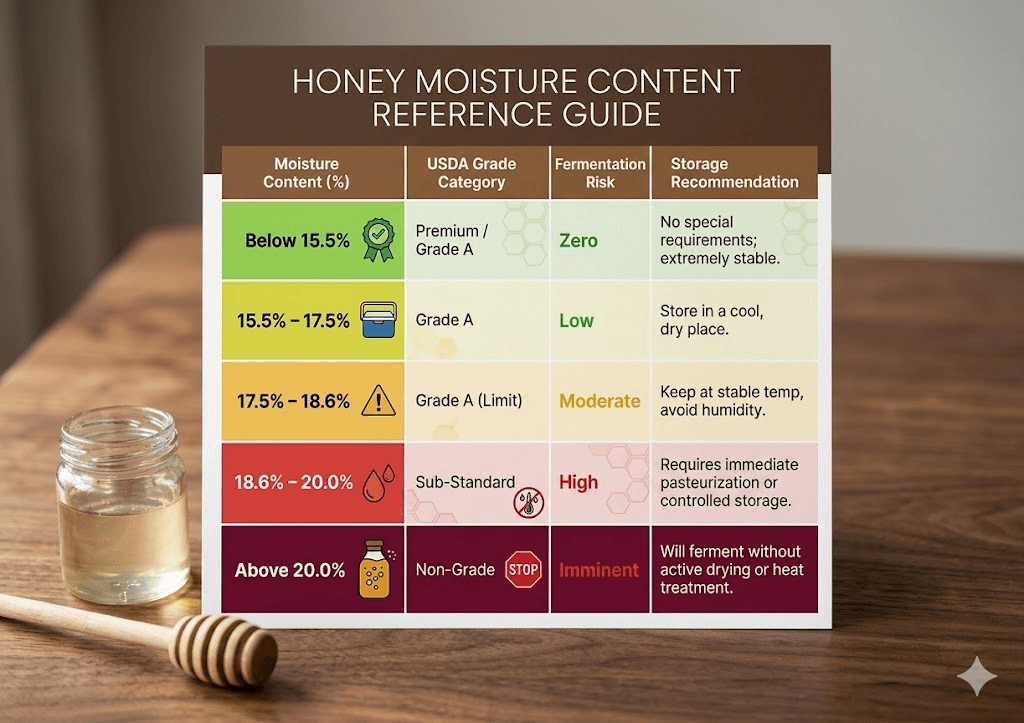
| Moisture Content (%) | USDA Grade Category | Fermentation Risk | Storage Recommendation | Commercial Use Case |
| Below 15.5% | Premium / Grade A | Zero | No special requirements; extremely stable. | Artisanal jars / Long-term storage. |
| 15.5% – 17.5% | Grade A | Low | Store in a cool, dry place. | Standard retail / Export quality. |
| 17.5% – 18.6% | Grade A (Limit) | Moderate | Keep at stable temps; avoid humidity. | Immediate retail / Bakery use. |
| 18.6% – 20.0% | Sub-Standard | High | Requires immediate pasteurization or cold storage. | Industrial food processing only. |
| Above 20.0% | Non-Grade | Imminent | Will ferment without active drying or heat treatment. | Not for raw retail sale. |
Pedagogical Discipline: Training the “Quality-First” Mindset
My 12 years of experience as a teacher have taught me that the most expensive part of any operation is the “Error of the Uninformed.” In the honey house, a single person who forgets to calibrate a refractometer can ruin a 2,000-pound batch of honey. Therefore, our “Refractometer Protocol” is part of a larger pedagogical framework.
We utilize “Redundancy Testing” as a teaching tool. Every new member of the team must perform ten blind tests, comparing their manual readings with the digital system until their variance is less than 0.1%. This isn’t just about the honey; it’s about building a culture of Metrological Integrity. In the United States, where food safety regulations like FSMA are strict, this disciplined approach ensures that our team is not just workers, but “Quality Technicians.” We treat the honey house like a laboratory, and the results speak for themselves in every jar we sell.
The Viral Landscape: Managing DWV and the Acute Paralysis Complex in North American Apiaries You will also be interested in the article, I tried to explain openly based on my own experience.