Introduction: The Modern Alchemist’s Field
In the traditional sense, alchemy was the pursuit of turning lead into gold. In the context of modern regenerative agriculture, the “alchemy” is far more profound and practical: it is the transformation of atmospheric carbon and inert soil minerals into living biomass and liquid gold—honey. For the professional apiarian and the agronomist, the boundary between the hive and the field has effectively vanished. We no longer view the apiary as a bystander to the farm, but as a critical component of a closed-loop, regenerative system.
Integrating apiary management with regenerative practices—specifically through the strategic use of cover crops—represents the pinnacle of ecological engineering. This synergy does more than just provide forage for bees; it restores soil structure, enhances water infiltration, and creates a biological resilience that chemical-heavy conventional farming simply cannot match. In this comprehensive exploration, we will delve into the technical mechanisms by which cover crops and honeybees work in tandem to revitalize the landscape of Lancaster and beyond.
Chapter I: The Soil-Bee Continuum
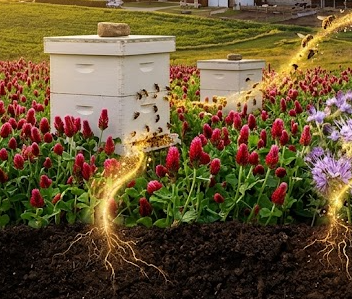
The fundamental premise of regenerative agriculture is that the soil is a living organism. When we speak of “Cover Crop Alchemy,” we are referring to the biological bridge built between the underground world of mycelium and bacteria and the aerial world of the honeybee.
- Carbon Sequestration and Nectar Secretion: High-functioning regenerative soils are carbon-rich. Plants grown in these soils have higher photosynthetic efficiency. When a plant is not struggling for nutrients, it can afford to be “generous” with its carbon. This generosity manifests as root exudates that feed soil microbes and, crucially for the beekeeper, as high-volume, high-sugar nectar.
- No-Till Stability: One of the pillars of regenerative farming is the elimination of tillage. For the apiarian, this is vital. Tillage destroys the nesting sites of native pollinators and disrupts the soil moisture levels that honey-producing cover crops rely on. A stable, no-till environment ensures that the “soil-nectar connection” remains uninterrupted throughout the growing season.
Chapter II: The Alchemical Selection of Species
Not all cover crops are created equal in the eyes of a honeybee. To achieve true integration, the agronomist must select species that fulfill the “Triple Bottom Line” of soil health, nitrogen fixation, and pollinator forage.
1. The Legume Legacy: Crimson and White Clovers
Clovers are the workhorses of regenerative alchemy. Their ability to fix atmospheric nitrogen into the soil reduces the need for synthetic fertilizers—which are often detrimental to bee gut health.
- Crimson Clover (Trifolium incarnatum): An excellent over-wintering cover. In the early spring, when the hive is expanding and the queen is laying at her peak, Crimson Clover provides a massive “protein punch” of pollen.
- White Dutch Clover (Trifolium repens): A low-growing perennial that can withstand foot traffic around the hives while providing a steady, long-term nectar flow that is world-renowned for its light, delicate honey profile.
2. Buckwheat: The Quick-Silver Growth
Buckwheat (Fagopyrum esculentum) is perhaps the most “alchemical” of all cover crops due to its rapid transformation. In just 30 to 45 days, it can go from seed to a shimmering sea of white blossoms.
- Phosphorus Solubilization: Buckwheat is a “phosphorus scavenger.” It draws up insoluble phosphorus from the soil and makes it available for the next crop.
- The Dark Gold: For the beekeeper, Buckwheat produces a deep, malty, mineral-rich honey that is highly prized in medicinal markets. It fills the “summer dearth”—that period in July and August when other flowers have withered.
3. Phacelia: The Nectar Machine
Phacelia tanacetifolia, often called “Lacy Phacelia,” is arguably the top nectar-producing cover crop in existence.
- Aggregate Stability: Its root system is superb at improving soil tilth.
- High-Octane Forage: Phacelia can produce up to 500-1000 lbs of honey per acre under ideal conditions. It is a staple in regenerative apiary management because it attracts not only honeybees but also a wide array of predatory wasps and hoverflies that provide natural pest control for the farm.
Chapter III: Timing and Succession – The “Continuous Bloom” Strategy
The greatest challenge in apiary-integrated farming is the “hunger gap.” A regenerative system must be designed like a relay race, where one cover crop hands off the forage baton to the next.
- Spring Awakening: Utilizing winter rye mixed with hairy vetch. While the rye provides the “carbon” and soil armor, the vetch provides the “nitrogen” and the early nectar.
- The Summer Bridge: Planting successions of Buckwheat and Sunn Hemp. Sunn Hemp is a tropical legume that thrives in the Lancaster heat, fixing massive amounts of nitrogen while offering unique floral structures for the bees.
- The Autumn Fortification: Late-season plantings of Mustard and Oilseed Radish. These brassicas perform “bio-fumigation” on the soil, killing off harmful nematodes, while their bright yellow flowers provide the final carbohydrate boost the bees need to survive the winter.
Chapter IV: The Nutrient Loop – Beyond Simple Sugars
In regenerative agriculture, we focus on nutrient density. A plant grown in mineral-balanced, microbially active soil does not just produce more nectar; it produces better nectar and pollen.
- Amino Acid Profiles: Bees require ten essential amino acids. In regenerative systems, the pollen from cover crops like Partridge Pea or Vetch has a more complete protein profile. This strengthens the bees’ vitellogenin (fat body) levels, which is the primary indicator of hive longevity and winter survival.
- Micronutrient Transfer: Minerals such as Boron, Zinc, and Manganese—essential for plant reproduction—are passed into the nectar. These trace elements act as co-factors for the enzymes we discussed previously (Diastase and Invertase). A mineral-starved field produces “empty calorie” nectar; a regenerative field produces “superfood” nectar.
Chapter V: Management Techniques – The Apiarian-Agronomist’s Handbook
To successfully integrate these two disciplines, the manager must adopt specific technical protocols:
1. The “Roller-Crimper” Method
Instead of using herbicides (like Glyphosate) to terminate cover crops, regenerative farmers use a roller-crimper. This mechanical tool flattens the cover crop, creating a thick mulch “armor” on the soil.
- Apiary Benefit: By waiting until the cover crop is at 50-75% bloom before crimping, the beekeeper maximizes the forage window. The resulting mulch keeps the soil cool, preserving the moisture needed for the next round of nectar-producing plants.
2. Interseeding and Relay Cropping
Don’t wait for one crop to end before starting another. Interseeding clover into standing corn or soybeans allows the bees to have a diverse diet even in the middle of a “monoculture” field. This diversity reduces the stress on the bees’ immune systems, making them more resistant to Varroa mites and atmospheric pathogens.
3. The 10% Refugia Rule
Always leave 10% of the cover crop standing and un-mowed. This “refugia” acts as a permanent nursery for beneficial insects and a backup food source for the apiary if weather conditions delay the next planting.
Chapter VI: The Economic Alchemy – Branding and Valuation
Regenerative agriculture is not just good for the planet; it is a powerful marketing tool for the modern beekeeper.
- The “Regenerative Organic” Label: Consumers in the United States are increasingly seeking out products that “give back” to the soil. Honey produced from a regenerative cover crop system can command a 30-50% price premium over conventional “wildflower” honey.
- Ecosystem Services: Beekeepers should be compensated for the pollination services they provide to the cover crops themselves. More efficient pollination of the cover crop leads to better seed set and more robust biomass for the farmer. It is a symbiotic financial relationship.
- Carbon Credits: As soil carbon sequestration becomes a tradable commodity, the presence of an apiary can be used as a biological indicator of a healthy, functioning ecosystem, potentially increasing the valuation of the farm’s carbon offsets.
Chapter VII: Challenges and Mitigation
No alchemy is without its “leaden” moments. The primary risks in this integration are:
- Bloat and Competition: Sometimes, a massive bloom of a single cover crop (like Canola) can cause bees to ignore native species. Diversity in the seed mix is the only solution.
- Weather Volatility: In Lancaster, unpredictable spring rains can wash away nectar. By using a “cocktail” of at least 5-8 different cover crop species, the manager ensures that even if one species fails, others will thrive.
Conclusion: The Golden Future of the Field
The integration of apiary management with regenerative agriculture is the ultimate expression of stewardship. It moves us away from the “extractive” model of farming—where we take from the soil and the bee until both are exhausted—and toward a “generative” model.
When we plant a cover crop, we are not just feeding the soil; we are feeding the hive. When the bees pollinate that crop, they are not just making honey; they are securing the future of the soil. This is the true Cover Crop Alchemy. It is a system where the “waste” of one process becomes the “fuel” for the next.
As we look toward the future of agriculture in Pennsylvania and the world, the “Foxats” model—where professional beekeeping is synonymous with professional agronomy—will be the gold standard. By focusing on the health of the soil, we ensure the health of the bee, and in turn, we secure the health of the human spirit through the pure, enzymatic, mineral-rich bounty of the earth.
Keywords for SEO and Distribution: regenerative agriculture, cover crops for bees, apiary management, soil health, nitrogen fixation, crimson clover, buckwheat honey, phacelia for pollinators, no-till beekeeping, carbon sequestration, Lancaster PA agriculture, sustainable honey production, pollinator habitat, soil-nectar connection, agricultural alchemy.
Author’s Note: This text is designed to be utilized as a cornerstone article for a professional digital presence, establishing the author as a premier expert in the intersection of agronomical science and apiculture engineering.
Chapter VIII: The Underground Exchange – Mycorrhizal Networks and Nectar Potency
To truly master the alchemy of the field, the modern agronomist must look past the root and into the fungal web. The relationship between Arbuscular Mycorrhizal Fungi (AMF) and cover crops is the hidden engine of the regenerative apiary. In a conventional system, high doses of synthetic phosphorus inhibit these fungi; in a regenerative system, we cultivate them as the primary “miners” of the soil.
- Mineral Bioavailability through Symbiosis: Mycorrhizal fungi extend the reach of plant roots by hundreds of times, accessing pockets of minerals—especially phosphorus, zinc, and copper—that the plant could never reach on its own. For the beekeeper, this is revolutionary. When a plant is plugged into a fungal network, its nectar is not just a sugar-water solution; it is a mineral-rich infusion. Zinc and copper, in particular, are essential for the production of Glucose Oxidase in the bee’s hypopharyngeal glands. By fostering AMF through no-till cover cropping, we are effectively “pre-loading” the nectar with the metallic catalysts the bees need to create antimicrobial honey.
- The “Glomalin” Shield: These fungi produce a sticky protein called glomalin, which acts as the “glue” for soil aggregates. Well-aggregated soil breathes better and retains more moisture. This “soil breathability” ensures that during the hot Lancaster summers, the cover crops (like Sunn Hemp or Phacelia) do not wilt and shut down nectar production. Instead, the fungal network acts as a hydraulic buffer, keeping the flowers “hydrated” and the nectar flowing even when the topsoil is dry.
Chapter IX: Precision Apiculture – Data-Driven Soil and Hive Integration
In the age of digital agriculture, the integration of the apiary and the field is no longer a matter of guesswork. We now have the tools to measure the “alchemy” in real-time. For the specialist who manages dozens of sites, Precision Apiculture is the bridge between agronomic theory and honey-room reality.
- Remote Sensing and NDVI: By utilizing satellite imagery and Normalized Difference Vegetation Index (NDVI) data, a manager can monitor the health and bloom-density of cover crops across hundreds of acres. This allows for the strategic movement of hives—placing them exactly where the “nectar peak” is occurring. If a field of Crimson Clover shows a high NDVI rating, it indicates high photosynthetic activity, which almost always correlates with higher sugar concentrations in the nectar.
- Soil Sensor Arrays: Deploying moisture and EC (Electrical Conductivity) sensors in the root zone of cover crops provides a “early warning system” for the apiary. When soil moisture drops below a certain threshold, the plant’s osmotic pressure changes, often making it impossible for the bee to extract nectar even if the flower is still visible. By automating this data collection, the agronomist-beekeeper can predict “honey dearths” before they happen and move hives to more hydrated “micro-climates” or riparian zones.
- The Python Pipeline: For the expert managing a complex network of business pages and technical websites, the same logic of automation applies here. Scripts can be developed to scrape local weather data, soil moisture levels, and even market prices for “Regenerative Certified” honey, creating a dashboard that dictates management decisions. This is the Digital Alchemy—turning raw data into the “gold” of efficient production.
Chapter X: Climate Resilience – The Thermal Mass of Cover Crops and Hive Microclimates
Extreme weather is the greatest threat to modern apiculture. Whether it is the late-spring frosts or the scorching heatwaves of the mid-Atlantic, the physical structure of the cover crop provides a “biological blanket” for the hive.
Chapter XI: The Holistic Landscape – Designing the “Agro-Apiary” of the 21st Century
The final stage of our alchemical journey is the transition from “farming with bees” to designing a truly Holistic Agro-Apiary. This requires a long-term vision where every square inch of the landscape is multi-functional.
- Riparian Buffers as Permanent Forage: Beyond the seasonal cover crops, a regenerative farm must integrate permanent “biological corridors.” These are strips of native trees and shrubs (like Basswood, Black Locust, and Willow) planted along waterways. These buffers prevent soil erosion and nutrient runoff into the Susquehanna watershed while providing the “heavy hitters” of the nectar world. A single mature Basswood tree can produce as much nectar as a half-acre of clover.
- The “Hive-Centric” Planting Plan: In a holistic design, fields are not planted in massive squares. Instead, they are planted in “concentric circles” or “sinuous strips” that radiate out from the central apiary. This reduces the “flight-energy cost” for the bees. If the most nutrient-dense forage is closest to the hive, the bees can make more “trips” per hour, leading to a exponentially higher honey yield.
- Regenerative Synergy and Human Health: Ultimately, the “Cover Crop Alchemy” is about more than just honey and soil—it is about the health of the community. A landscape that is rich in minerals, free of synthetic toxins, and buzzing with life is a landscape that heals. As a teacher and an expert, your role is to demonstrate that Agronomy is a Pedagogical Tool. By showing the connection between the soil mineral, the bee’s enzyme, and the human’s immunity, we are teaching a new generation how to live in harmony with the firmament.