Introduction: The Invisible Pathogens Behind Colony Collapse
In the modern apicultural environment of the United States, the Varroa mite is often described as the primary enemy. However, from a pathological perspective, the mite is merely a “dirty needle.” The true executioners of the colony are the viruses it vectors. Deformed Wing Virus (DWV) and the Acute Paralysis Complex (ABPV, IAPV, KBV) have fundamentally changed the biological math of beekeeping. As an agronomist, I have spent years studying viral vectors in crops; applying that same rigor to the apiary reveals that managing viruses requires a strategy that goes beyond simple mite counts. This article explores the hidden viral landscape and the technical protocols necessary to mitigate these invisible threats.
Section 1: The Vector Dynamics – How Mites “Unlock” Viral Pathogenicity
Before the arrival of Varroa destructor, many honeybee viruses were “latent”—they existed in the colony at low levels without causing significant harm. The mite changed the transmission route from Vertical (mother to offspring) to Horizontal (injection directly into the hemolymph).
When a mite pierces the bee’s integument to feed on the fat body, it creates a direct gateway for viral replication. In the high-stress environments of US commercial pollination, this “mechanical transmission” leads to a rapid spike in viral titers. As a scientist, I look at the Viral Tipping Point: the moment when the concentration of DWV particles in a single bee exceeds the threshold that its immune system can suppress. Once this point is reached, the colony enters a “death spiral” that even late-season mite treatments cannot reverse.
Section 2: The Fat Body Connection – An Agronomist’s View on Immunity
The most critical discovery in recent bee science is that mites feed on the fat body, not just the “blood” (hemolymph). The fat body is the bee’s equivalent of the human liver—it is the center of the immune system, the site of protein synthesis (Vitellogenin), and the primary organ for detoxification.
When viruses attack the fat body, they aren’t just making the bee sick; they are dismantling its ability to fight back. In my 15 years as an agronomist, I have seen how nutritional stress in plants amplifies viral damage. In the apiary, if the bees are foraging on nutrient-poor US monocultures while fighting viral replication in their fat bodies, their lifespan is cut by 50%. Our management must focus on Physiological Buffering—providing the building blocks necessary for the bees to repair the cellular damage caused by viral “hacking.”
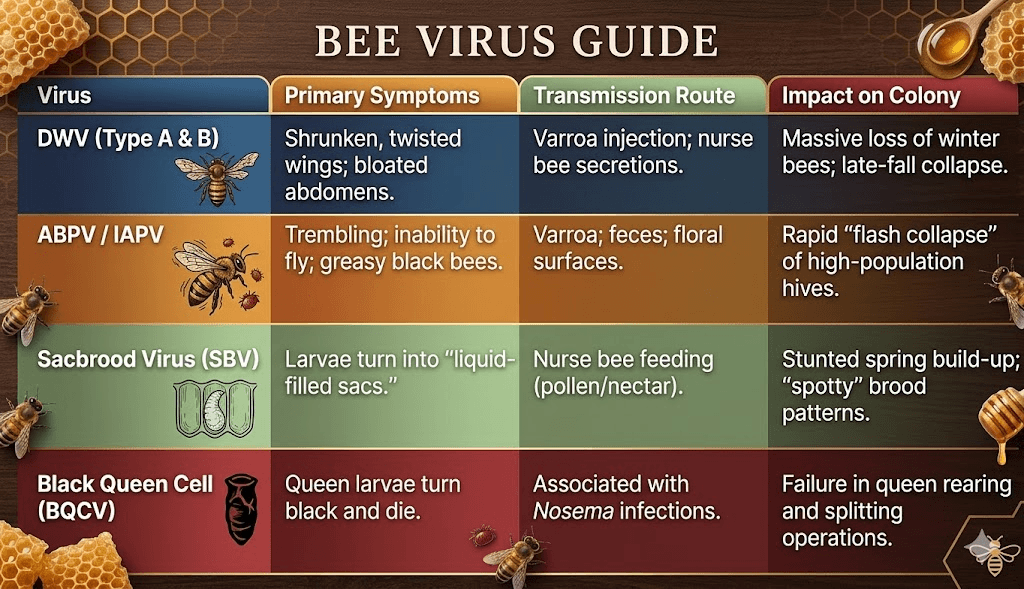
Section 3: Technical Comparison – The Major US Bee Viruses
Understanding the specific viral signature of your apiary is essential for professional-grade management.
Section 4: The Developer’s Tool – Python Scripts for Mite-to-Virus Correlation
As an automation developer, I don’t trust visual inspections alone. I have developed a Python-based Correlation Engine that predicts viral risk levels based on historical mite data and local humidity levels.
The “Viral Surge” Algorithm
The script utilizes a Lag-Time Model. In the US climate, we know that a “Mite Peak” in August typically leads to a “Viral Peak” in October. My script analyzes the “Slope of the Mite Curve.” If the mite population grows at a rate faster than 15% per week, the script triggers a “Viral Red Alert.” This alert tells me that even if I kill the mites today, the viral titers are already at dangerous levels. Consequently, the system suggests an immediate “Immune-Stimulant Drench”—a specialized feed infused with essential amino acids and herbal extracts that have been shown to upregulate the bee’s natural RNA interference (RNAi) pathways. By using code to anticipate the viral surge, I can save colonies that would otherwise look healthy in September but be dead by December.
Section 5: The Teacher’s Methodology – Implementing “Soft-Start” Breeding
In my 12 years of pedagogical practice, I’ve learned that the best results come from long-term, disciplined systems. In beekeeping, this means Genetic Selection for Viral Tolerance.
In my American apiary, I implement a “Soft-Start” protocol. We identify colonies that maintain high productivity and low DWV symptoms despite having moderate mite levels. These are our “Genetic Champions.” They aren’t necessarily “mite-free,” but they are Virus-Tolerant.
As a teacher, I keep a detailed “Report Card” for every queen in my digital ledger. We score them on:
- Overwintering Vigor: Survival of the viral “winter stress.”
- Brood Solidness: Lack of virus-induced larval removal.
- Hygienic Behavior: The ability to sense and remove DWV-infected pupae before they emerge.
By breeding only from the “A-grade” students, we are slowly building a lineage that can survive the modern North American viral landscape with minimal chemical intervention.
Section 6: Advanced Remediation – The “Pollen-Lipid” Protocol
If a colony shows early signs of DWV, we don’t just “treat for mites.” We implement a Total System Reset. As an agronomist, I treat this like “Soil Remediation.”
- Lipid Loading: We provide a high-fat pollen supplement (containing Omega-3 and Omega-6 fatty acids). Lipids are the raw materials for cell membrane repair—crucial for bees whose fat bodies have been compromised by viral replication.
- Essential Oil Aromatherapy: I use a controlled delivery of Thymol and Eucalyptus vapors. While these have a minor effect on mites, their primary role in my protocol is as a “sanitizer” of the hive atmosphere, reducing the horizontal spread of viruses between foragers.
- Requeening: A “Viral-Resistant” queen is the ultimate fix. If a hive is struggling, we replace the genetics immediately. A fresh queen with a stronger pheromone signature often boosts the colony’s morale and “social hygiene,” leading to a more aggressive removal of infected individuals.
Conclusion: The New Frontier of Bee Health
Managing honeybees in the 21st-century United States is no longer just about entomology; it is about Virology and Systems Biology. The beekeepers who will thrive are those who can see the invisible—who understand that the mite is only the beginning of the story. By integrating the technical precision of Python, the nutritional wisdom of Agronomy, and the disciplined selection of a Master Teacher, we can navigate this complex viral landscape and ensure our colonies remain productive and resilient for years to come.
RNA Interference (RNAi): The Genetic Scalpel of Honeybee Defense
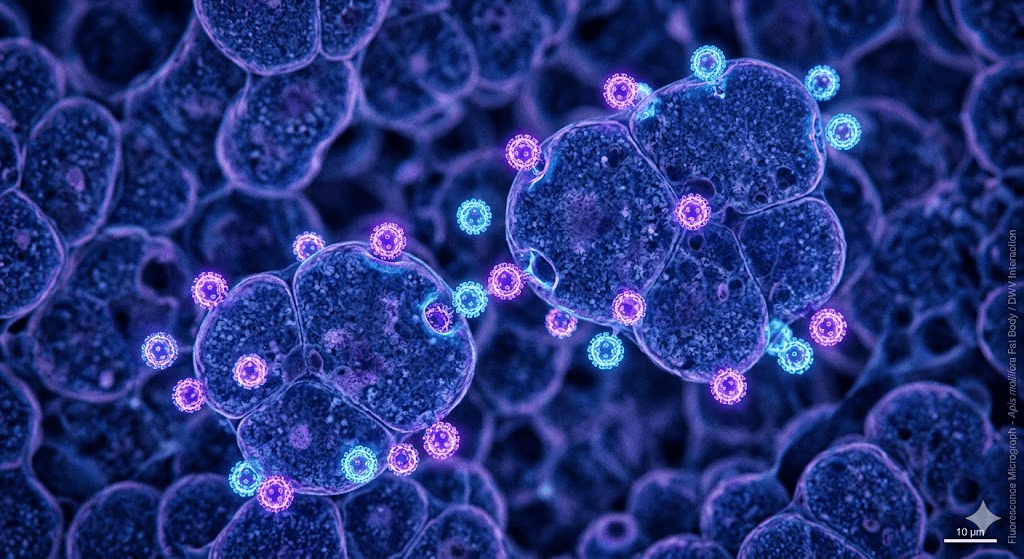
In my work as an agronomist, I have often seen how gene-silencing technology is used to protect high-value crops from persistent pests. In the apiary, the honeybee possesses a similar, albeit natural, mechanism known as RNA Interference (RNAi). This is the colony’s primary cellular defense against viral “hacking.” When a virus like DWV enters a bee’s cell, it releases its long-strand RNA to hijack the bee’s protein-making machinery. The bee’s immune system responds by deploying specialized enzymes (like Dicer) that chop the viral RNA into tiny fragments, effectively “silencing” the infection before it can replicate.
However, the modern North American environment places a heavy burden on this genetic scalpel. Sublethal pesticide exposure and nutritional gaps can “blunt” the RNAi response, leaving the bee’s cells wide open to viral takeover. From a management perspective, we must view RNAi support as a form of Genetic Soil Management. By providing targeted micronutrients—specifically stable RNA-precursors and riboflavin—we can enhance the bee’s ability to produce these defensive enzymes. In my professional protocol, I prioritize feeding during the “critical window” of late August, when the bees are building the immune systems of the winter generation. We are not just feeding bees; we are equipping their cells for a genetic war that determines whether the colony survives the February thaw.
The Hive as a Superorganism: Social Immunity vs. Viral Loads
My 12 years of pedagogical experience have taught me that a classroom’s success depends on the collective health of the group, not just the individual. In apiculture, we call this the Superorganism. A honeybee colony has developed a suite of “Social Immune” behaviors—such as mutual grooming, hygienic removal of diseased larvae, and even “social fevers”—to manage the viral load. But viruses are masters of subversion. New research into the US viral landscape suggests that viruses like IAPV (Israeli Acute Paralysis Virus) can actually modify bee behavior to facilitate their own spread.
When a forager is heavily infected with the Acute Paralysis Complex, her “social compass” is often broken. She may spend more time near the hive entrance or drift into neighboring hives, effectively acting as a biological Trojan Horse. As a professional beekeeper, I have learned to look for these Behavioral Discontinuities. In a healthy hive, the “social friction” (the constant interaction between bees) serves to sanitize the population. But when viral titers reach a critical mass, the social structure collapses—grooming stops, and the hive becomes “biologically quiet.” My management strategy involves “Stress Decoupling.” By reducing the density of hives in my apiary during high-viral-load years, I am effectively implementing “social distancing” for my bees, breaking the horizontal transmission chain and allowing the colony’s natural social immunity to catch up with the infection.
Automated Symptom Recognition: Scaling the Teacher’s Eye with Computer Vision
As an automation developer, my goal is always to solve the problem of “Human Scalability.” A teacher can only watch thirty students at a time, and a beekeeper can only inspect a few dozen frames a day. To manage a commercial-scale operation in the USA, we need to scale the “Master’s Eye” using technology. I have been experimenting with Computer Vision (CV) algorithms integrated into hive-top cameras to detect early-stage viral symptoms.
Using libraries like OpenCV and TensorFlow, I’ve trained a model to recognize the specific “trembling” motion associated with Chronic Bee Paralysis Virus (CBPV) and the “shriveled wing” morphology of DWV. The system scans the landing board 24/7, counting the frequency of these symptoms. This creates a Viral Heat Map of my entire operation. Instead of waiting for a monthly inspection, I get a real-time notification on my smartphone: “Yard B, Hive 14: 15% increase in symptomatic foragers.”
This is the ultimate marriage of my three careers: the Agronomist’s understanding of pest thresholds, the Teacher’s eye for detail, and the Developer’s ability to automate. This data allows for “Surgical Intervention.” If only one hive in a yard of twenty is showing a high viral signature, I can remove and isolate that hive immediately, preventing the yard-wide collapse that often occurs in the late American autumn. We are moving toward a future where the health of the hive is monitored in bits and bytes, allowing the beekeeper to act with the precision of a surgeon.
The Propolis Envelope: The Biological Frontier of Colony Defense