The Thermal Dance: Finding the Sweet Spot Between Viscosity and Vitality
In the professional American honey house, temperature is the most powerful variable we control. Extraction is fundamentally a race against viscosity. As a professional agronomist, I view honey not merely as a sweetener, but as a living biological matrix of enzymes, volatile aromatics, and bioactive compounds. The challenge we face in the North American climate—where harvest nights can drop into the 50s ($^\circ\text{F}$)—is that cold honey is incredibly viscous, clinging to the wax cells with stubborn tenacity. To maximize yield, many commercial operations resort to excessive heat, but as a scientist, I know that heat is the primary enemy of honey quality. Our “Thermodynamic Protocol” focuses on the precise application of kinetic and thermal energy to ensure we extract every drop of honey while keeping it in its “raw,” enzymatically active state.
The Arrhenius Principle in the Honey House: Viscosity vs. Molecular Integrity
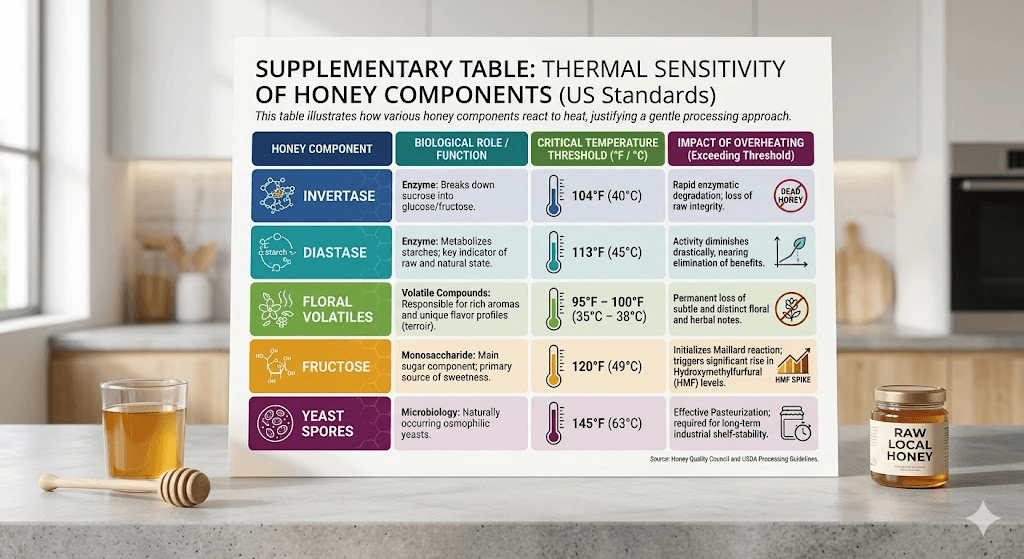
From a fluid dynamics perspective, the viscosity of honey decreases exponentially as temperature increases. However, there is a “biological ceiling” that we must never cross. In my 12 years of pedagogical experience teaching complex biological systems, I explain this through the degradation of Diastase and Invertase—the key enzymes that prove honey is “raw.”
In the United States, the industry standard for “high-quality” extraction usually hovers around 90°F to 95°F ($32^\circ\text{C}$ to $35^\circ\text{C}$). This mimics the natural temperature of the brood nest. At this “Biological Equilibrium,” the honey flows with 60% less resistance than at room temperature, yet the delicate HMF (Hydroxymethylfurfural) levels remain stable. If a beekeeper pushes the warm room to 110°F to speed up the uncapper, they are effectively “cooking” the honey, dissipating the floral esters that give North American varietals, like Sourwood or Basswood, their unique terroir. Our goal is Thermal Precision, not thermal force.
The “Warm Room” Logic: Python-Controlled PID Regulation
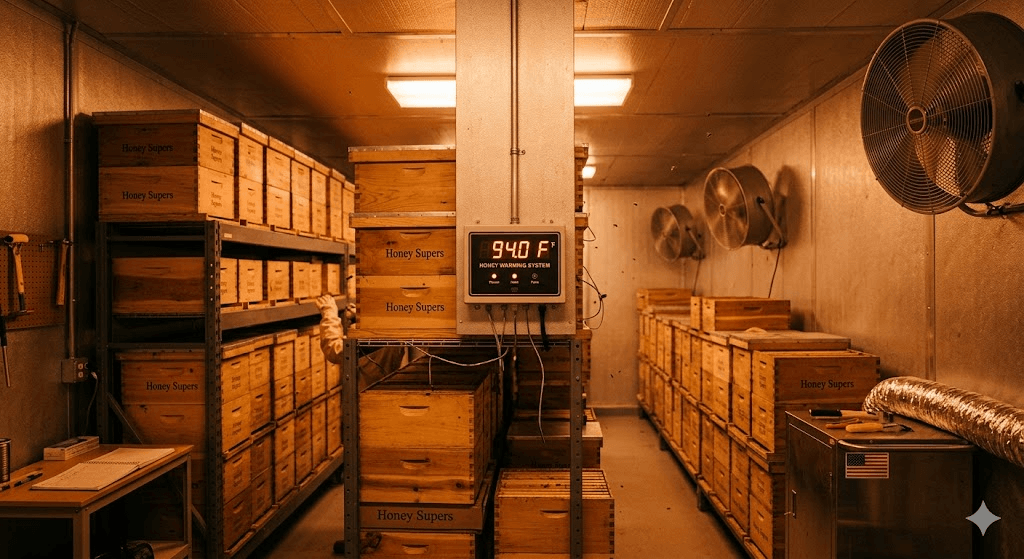
As an automation developer, I don’t rely on the imprecise thermostats found on standard space heaters. We have engineered a Digital Warm Room controlled by a Python-based PID (Proportional-Integral-Derivative) loop. Using high-accuracy DHT22 sensors placed at three different heights in the room, our system manages the “Thermal Gradient.”
Because heat rises, a standard room will be 100°F at the ceiling and 80°F at the floor—this leads to inconsistent extraction. Our Python script manages industrial circulation fans to ensure a uniform 94°F environment. The system monitors the “Thermal Soak” of the supers. We don’t pull supers into the extractor until the core temperature of the wax frames has reached equilibrium. This data-driven approach ensures that our VFD (Variable Frequency Drive) on the extractor can run at optimal speeds without the risk of “comb blowouts” caused by pockets of cold, heavy honey. We are using code to manage the laws of thermodynamics.
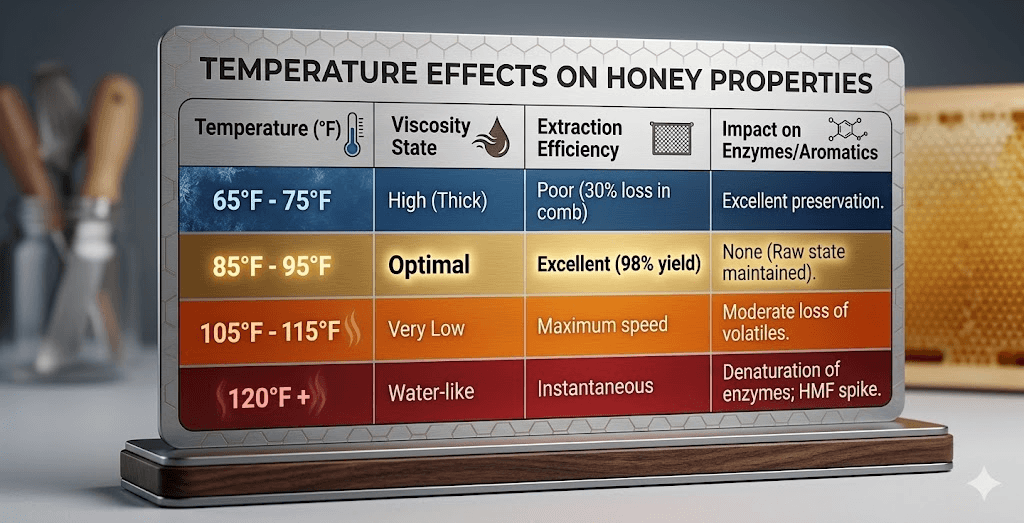
Thermal Impact Matrix: Quality vs. Efficiency
This table illustrates the critical thresholds we manage during the North American harvest to balance throughput with USDA Grade A quality.
The Latent Heat of Filtration: Clearing the Batch without Pressure
One of the most authentic challenges in the US honey house is removing “bee parts” and wax cappings without using high-pressure micro-filtration that removes pollen. In my “Thermodynamic Protocol,” we leverage Latent Heat. Once the honey leaves the extractor, it passes through a series of jacketed stainless steel sumps maintained at a steady 98°F.
At this precise temperature, the wax particles have a lower specific gravity and rise to the surface much faster than at room temperature. We use “Gravity Clarification”—allowing the laws of physics to do the work that others do with expensive, honey-damaging pumps. By maintaining the honey at “Hive Temperature” throughout the filtration phase, we can use 400-micron stainless steel meshes that catch impurities but allow every grain of local North American pollen to pass through. This is the hallmark of professional beekeeping: using science to keep the product as close to the hive as possible.
Centrifugal Force vs. Wax Elasticity: The Physics of the Spin
As a teacher, I often demonstrate that extraction is a balance between Kinetic Energy and Structural Integrity. Wax is a thermoplastic; its elasticity changes with temperature. If the frames are too warm (above 100°F), the wax becomes soft and “plastic,” making it prone to collapsing under the G-forces of a radial extractor.
Our Python-controlled VFDs are programmed with a “Thermal-Compensated Ramp Profile.” If the warm room sensors indicate the frames are on the higher end of the thermal scale, the script automatically reduces the peak RPM to protect the comb. Conversely, if the honey is slightly cooler, the script increases the spin duration to ensure a clean frame. This integration of Material Science and Automation allows us to maintain a high-speed extraction line while ensuring our valuable drawn comb—the “infrastructure” of the hive—is returned to the bees perfectly intact for the next season.
Conclusion: The Master Beekeeper as a Thermal Engineer
Ultimately, the thermodynamics of extraction is about respect—respect for the bees’ hard work and respect for the chemical complexity of the nectar. By applying the rigorous analytical standards of an agronomist, the technical precision of a developer, and the clarity of a master teacher, we transform the honey house into a temple of quality. We don’t just extract honey; we preserve a biological legacy. In the competitive US market, where “purity” is a brand, our mastery of heat and physics is our greatest competitive advantage.
The Thermodynamic Paradox: Humidity Management in the Heated Honey House
As an agronomist, I have spent years managing the interaction between heat and moisture in seed storage, and I apply the same “Hygroscopic Shield” protocol to the honey house. There is a dangerous thermodynamic paradox that many American beekeepers overlook: as you increase the temperature of your warm room to lower honey viscosity, you simultaneously increase the air’s capacity to hold water. If your “Warm Room” is at 95°F ($35^\circ\text{C}$) but lacks professional-grade dehumidification, the vapor pressure differential will actually drive moisture from the air into your honey, even through the wax cappings.
In my operation, I treat the air as a thermodynamic fluid. We utilize a Python-monitored “Psychrometric Logic” that calculates the dew point in real-time. If the ambient humidity in our Iowa facility spikes during a summer storm, the system recognizes that the heated honey is at risk of absorbing moisture. Instead of just heating the air, the system triggers a secondary cooling-dehumidification cycle to “strip” the water while maintaining the honey’s core temperature. This ensures that when the frames hit the extractor, they are not only fluid but have a stabilized moisture content that meets the strictest “Grade A” requirements. We are managing the Vapor Pressure Deficit (VPD) to ensure that the heat we use for extraction doesn’t become a vehicle for fermentation.
The HMF Frontier: Managing the Kinetics of Fructose Degradation
One of the most authentic challenges in the professional US honey trade is the management of Hydroxymethylfurfural (HMF). HMF is a heat-induced byproduct of the breakdown of fructose, and it is the primary “silent indicator” used by laboratory auditors to determine if honey has been overheated or poorly stored. In the high-stakes world of North American retail and export, an HMF level above 40 mg/kg can disqualify a batch from “Premium” status.
Through my experience as a teacher and scientist, I explain this as a time-temperature equation. The formation of HMF follows a predictable kinetic curve: the higher the temperature, the faster the reaction. However, a short exposure to 100°F ($38^\circ\text{C}$) during extraction is far less damaging than a long-term soak at 85°F ($29^\circ\text{C}$) in a poorly insulated warehouse. My “Thermal Integrity Protocol” uses Python to track the Cumulative Heat Units each batch receives. By logging every hour the honey spends above 90°F, we can calculate the “Freshness Decay.” This allows us to prioritize the shipping of batches that had a slightly longer extraction window, ensuring that our customers always receive a product with the lowest possible HMF levels and the highest enzymatic vitality. We are using chemical kinetics to guarantee shelf-life.
Infrared Thermal Mapping: Using Computer Vision for Non-Invasive Quality Control
As an automation developer, I have moved beyond the “finger-test” to determine if honey is warm enough to extract. We have integrated FLIR (Forward Looking Infrared) sensors into our automated uncapping line. As a stack of supers enters the extraction area, a Python-based computer vision script scans the “Thermal Profile” of the frames.
This isn’t just about the average temperature; it’s about Thermal Uniformity. Honey is a poor conductor of heat. Often, the center of a honey super will be 10°F cooler than the outer frames. If you process these “cold-core” supers, the extraction yield drops, and the strain on the centrifugal motor increases significantly. My script analyzes the IR histogram of the frames; if it detects a “Cold Core” anomaly, the conveyor automatically pauses and shunts those supers back to a high-velocity “Flash-Heating” zone. This ensures that every frame processed by the automated line has a perfectly uniform viscosity. This level of technical precision—using IR data to drive mechanical decisions—is what allows us to scale our operation while maintaining the artisanal quality that the American “Raw Honey” market demands. We are seeing the heat that others are only guessing at.

Don’t miss out on new material Data-Driven Extraction: Optimizing Honey House Efficiency with Automation.