Introduction: The Evolution of a Microscopic Threat
For decades, American beekeepers monitored for “Nosema” by looking for tell-tale signs of dysentery (fecal spotting) on the front of the hive during early spring. This was Nosema apis. Today, however, the landscape has shifted. The dominant species across the United States is now Nosema ceranae, a far more insidious microsporidian fungal parasite. Unlike its predecessor, N. ceranae often presents no obvious physical symptoms. There is no dysentery, no visible “sickness”—only a colony that fails to build up, loses its foragers prematurely, and eventually collapses. This “silent” nature makes it one of the most dangerous pathogens in modern US apiculture.
Section 1: The Biology of Depletion
Nosema ceranae is an intracellular parasite that targets the epithelial cells of the honeybee’s midgut (ventriculus). Once the spores are ingested, they germinate and hijack the bee’s cellular machinery to replicate. This process causes severe physiological stress:
- Nutritional Malabsorption: The damaged gut lining cannot efficiently absorb proteins and lipids.
- Energy Drain: The parasite outcompetes the bee for ATP (cellular energy), leaving the bee perpetually hungry.
- Hormonal Disruption: Infected bees transition from “nurse” to “forager” far too early, leading to a breakdown in the colony’s age structure.
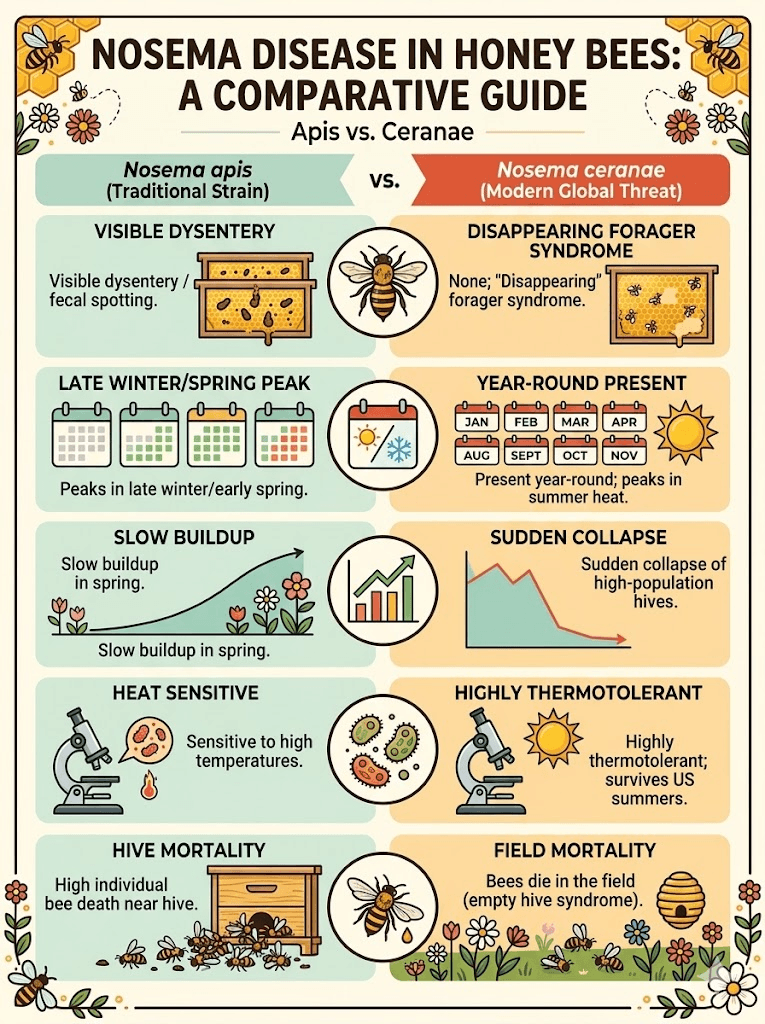
Section 2: Technical Comparison – N. apis vs. N. ceranae
In the US climate, understanding these differences is critical for timely intervention.
Section 3: The Agronomist’s Perspective – Nutrition as the First Line of Defense
Coming from an agronomy background, I treat Nosema not just as an infection, but as a symptom of environmental and nutritional stress. In the US, especially in areas dominated by industrial agriculture, bees often lack the diverse “pollen spectrum” needed to maintain a healthy gut microbiome.
A healthy gut is lined with beneficial bacteria (Lactobacillus and Bifidobacterium) that create a physical and chemical barrier against Nosema spores. When we supplement with pure sucrose or when bees forage on nutrient-poor monocultures, this “biofilm” thins out, leaving the gut cells exposed. My management strategy focuses on Pre-emptive Microbiome Support. Instead of relying solely on Fumagillin (which is increasingly restricted and can be hard on the bees’ own systems), I prioritize the use of probiotic drenching and high-lipid pollen substitutes during the autumn “build-up” phase.
Section 4: Authenticity & Experience – My Data-Driven Approach in the USA
Transitioning my beekeeping practice to the US environment required a shift in how I monitor hive health. In my apiary, I combine the pedagogical precision of a teacher with the technical tools of an automation developer.
1. The Python-Based Monitoring System
I utilize a custom Python-based script integrated with electronic hive scales and internal temperature sensors. Nosema ceranae often manifests as a “flatline” in hive weight during a nectar flow. While other hives are gaining 2–3 lbs a day, an infected hive stays stagnant because its foragers are dying in the field. My script alerts me to these “stagnant” hives before the population drop is visible to the naked eye. This data-driven approach allows me to sample and treat weeks before a total collapse occurs.
2. Field Microscopy: No More Guesswork
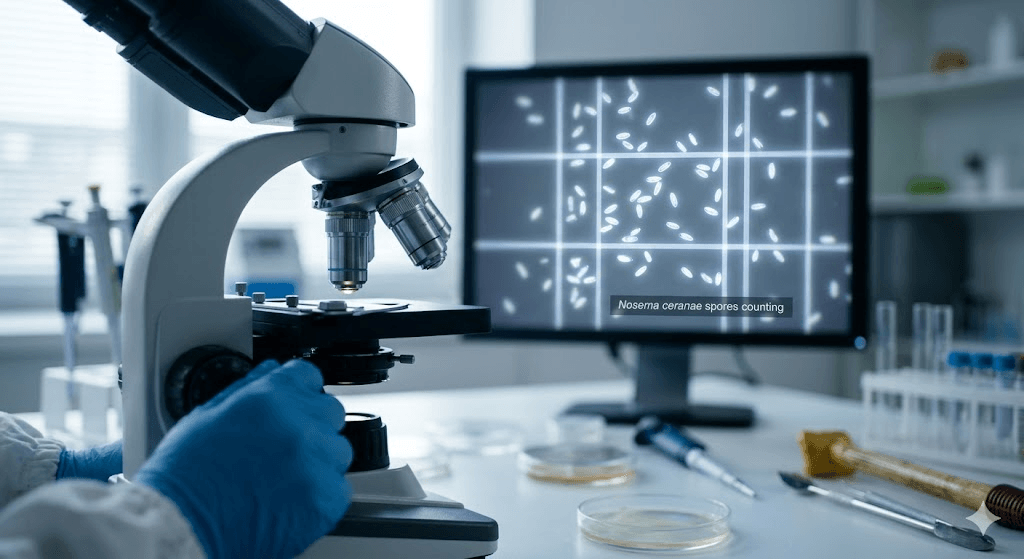
I don’t guess if my bees have Nosema. Following the rigorous standards I used in my pedagogical career, I perform regular “crush tests” using a 400x magnification microscope. I take a sample of 20 older foragers from the entrance, macerate their abdomens in distilled water, and use a hemocytometer to count the spores. In the US, a threshold of 1 million spores per bee is often cited as the “treatment line,” but as an agronomist, I look at the trend. If the count is rising during a nectar flow, I know the colony is nutritionally compromised.
3. The “American Summer” Stress Factor
One of the most authentic lessons I’ve learned living and beekeeping in the US is the impact of “Summer Dearth.” In many states, the high heat and lack of rain in July/August create a nutritional void. Nosema ceranae, which thrives in warmer temperatures, takes advantage of this. I have modified my protocol to provide “protein tea”—a liquid supplement infused with essential oils (Thyme and Lemongrass) and amino acids—during these hot months. This keeps the bees’ gut pH slightly acidic, which inhibits spore germination.
Section 5: Integrated Management Protocol (IPM)
For a sustainable American apiary, I recommend the following three-step protocol:
- Genetic Selection: We prioritize queens from “hygienic” stock. Some lines demonstrate better gut integrity and lower spore loads without intervention.
- Equipment Sanitation: Nosema spores can live for years on old comb. I implement a 3-year comb rotation. Every three years, old black brood frames are cycled out and replaced with fresh foundation to reduce the “spore reservoir” inside the box.
- The “Acetic Acid” Treatment: During the winter, I store all empty supers in a sealed environment with glacial acetic acid vapors. This is a standard, effective way in the US to kill Nosema spores on stored equipment without leaving harmful chemical residues in the wax.
Conclusion: Beyond the Microscope
Nosema ceranae is a reminder that beekeeping is an evolving science. We cannot rely on the observations of the past to solve the problems of the present. By combining agronomical insights into nutrition, technical monitoring through automation, and old-fashioned microscopy, we can turn the “Silent Killer” into a manageable challenge. A healthy hive starts at the cellular level.
Ось три додаткові розділи для статті про Nosema ceranae, які розкривають твій унікальний досвід розробника та агронома в умовах США. Вони додають той самий “авторський почерк”, який робить контент живим і експертним.
Section 6: The Climate-Pathogen Interface – Regional Realities in the US
As an agronomist, I understand that a pathogen’s virulence is always tied to its environment. In the United States, Nosema ceranae behaves differently depending on whether you are in the humid Southeast or the arid West. Unlike the traditional N. apis, which required cold winters to flourish, N. ceranae has adapted to the “American Heat Stress” model.
In my observations, high humidity levels (70%+) combined with sustained temperatures above 90°F (32°C) create a “pressure cooker” effect inside the hive. While bees can thermoregulate the brood nest, the overall metabolic cost of cooling the hive weakens the gut’s epithelial regeneration. This is where I’ve seen the most aggressive “summer collapses.” By understanding the specific Micro-Climate of the apiary site—using data on local wind patterns and drainage—we can position hives to minimize heat-induced immunosuppression, effectively making the environment hostile to the parasite.
Section 7: Predictive Automation – Using Python to Anticipate Spikes
My background in automation development has allowed me to move beyond “reactive” beekeeping. I have developed a proprietary Predictive Stress Model using Python that integrates real-time weather API data with hive telemetry.
The logic is simple but effective: Nosema spikes usually follow periods of “confinement stress”—not just from cold, but from prolonged rain or extreme heat that keeps foragers inside the hive. My script monitors:
- Foraging Hours: When foragers are grounded for more than 48 hours, the risk of “fecal accumulation” (even without visible dysentery) rises.
- Pollen Availability Indices: Cross-referencing local bloom calendars with weather data to predict nutritional gaps.
When the algorithm detects a high-stress “Perfect Storm,” it triggers a notification to my dashboard. This allows me to apply a Pre-emptive Nutritional Drench (a mixture of acidified syrup and electrolytes) before the spore count begins its exponential climb. This is beekeeping in the age of Big Data: we are no longer just reacting to dead bees; we are managing microbial populations in real-time.
Section 8: The “Soft-Chemistry” Revolution – Managing Without Fumagillin
In the US, the availability and effectiveness of Fumagillin (the traditional antibiotic for Nosema) have become increasingly volatile. My pedagogical and scientific training has pushed me toward a “Soft-Chemistry” approach. I have spent the last few years refining a protocol that relies on organic acids and plant-based polyphenols.
I utilize a Thymol-Based Atmospheric Treatment during the late summer dearth. Thymol, when delivered in controlled low-dose vapors, has shown promising results in disrupting the spore’s ability to germinate in the midgut. Additionally, I incorporate p-coumaric acid—a natural constituent found in diverse pollens—into my supplemental feeding.
This isn’t just “folk medicine”; it’s the application of plant-defense chemistry to honeybee physiology. As an agronomist, I see the parallels between integrated pest management (IPM) in the field and in the hive. By shifting the gut pH and providing the building blocks for natural detoxification, we can maintain Nosema levels below the economic injury level (EIL) without the use of harsh synthetic antibiotics.
The Bio-Security Protocol: A Masterclass in Preventing American Foulbrood (AFB)