In the hierarchy of apicultural threats, American Foulbrood (Paenibacillus larvae) stands alone as the most devastating bacterial pathogen. Unlike mites or fungal infections, AFB is not a condition that a colony can simply “overcome” with standard treatments. It is a highly contagious, spore-forming bacteria that targets the honeybee at its most vulnerable stage: the larva. For the professional beekeeper, understanding the biological mechanics of AFB is not just about hive health; it is about the preservation of the entire regional apiary infrastructure. A single undetected case can serve as a biological epicenter, spreading through robbing and drifting until an entire landscape of bees is compromised.
The true danger of AFB lies in the longevity and resilience of its spores. Research has confirmed that P. larvae spores can remain viable and infectious for over fifty years, surviving extreme temperatures, UV radiation, and even chemical disinfectants that would kill most other pathogens. This persistence demands a shift from a reactive mindset to a rigorous, proactive bio-security protocol.
The Pathogen’s Persistence: Understanding the Spore Cycle
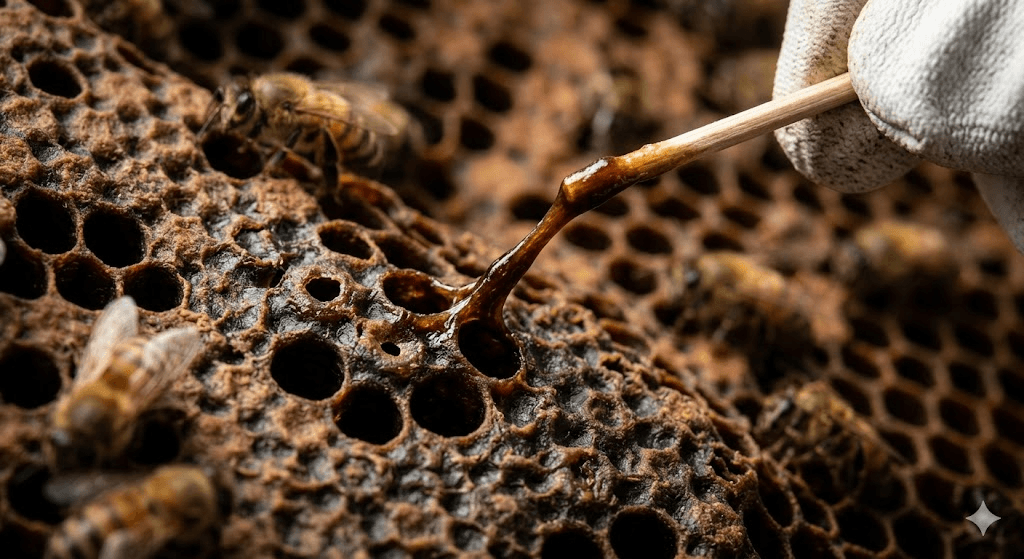
The infection cycle of American Foulbrood is a masterpiece of evolutionary efficiency. The bacteria enter the larva through contaminated food provided by nurse bees. Once inside the gut, the bacteria proliferate, eventually killing the larva after the cell has been capped. This is where the “foul” nature of the disease manifests. The dead larva transforms into a dark, glue-like mass that eventually dries into a “scale” that is practically inseparable from the cell wall.
Each dead larva can contain billions of spores. When house bees attempt to clean the cell, they inadvertently coat their mouthparts and bodies in spores, which are then passed to the next generation of larvae. This internal cycle is why the disease progresses exponentially. From a management perspective, the goal is to identify the infection in its early “ropiness” stage before the massive buildup of dormant spores occurs. Mastery of this diagnostic window is what prevents a single infected frame from becoming a catastrophic loss.
The Field Diagnostic: Beyond the Standard Ropiness Test
While the “matchstick” or “rope test”—where a stick is inserted into a suspicious cell to see if the remains draw out into a long, gooey thread—is the classic diagnostic, the expert beekeeper looks for more subtle, early-onset indicators. These include “pepperbox” brood patterns, where the regularity of the brood nest is shattered by empty cells, and “sunken cappings.”
A healthy capping should be slightly convex and uniform in color. AFB causes the cappings to become greasy, dark, and concave, often with tiny perforations where the bees have attempted to investigate the dying larva inside. Furthermore, there is a distinct, pungent odor—often described as “old locker room” or “decaying fish”—that emanates from a heavily infected hive. However, relying on smell is a late-stage strategy. Professional bio-security involves the use of modern lateral flow devices (AFB test kits), which provide lab-quality results in the field within ten minutes, allowing for immediate quarantine and decision-making.
The Ethics of Destruction vs. The Myth of Treatment
One of the hardest lessons in professional apiculture is the realization that there is no “cure” for American Foulbrood. While antibiotics like Terramycin can suppress the vegetative stage of the bacteria and hide the clinical symptoms, they do absolutely nothing to kill the spores. In fact, using antibiotics often makes the problem worse by masking the disease while it continues to spread through the hive’s honey and wax.
In the United States and many European countries, the legal and ethical protocol for a confirmed AFB case is clear: the destruction of the colony and the burning of the woodenware. This “scorched earth” policy is the only way to ensure the spores are permanently removed from the environment. Attempting to “save” an AFB-infected hive is a violation of the beekeeper’s social contract with their peers. At Foxats, we emphasize that the long-term health of the beekeeping community depends on the courage to eliminate a single source of infection to protect the thousands of healthy hives in the surrounding area.
Bio-Security in the Tool Shed: Sanitization Protocols
The spread of AFB is often facilitated by the beekeeper’s own equipment. Hive tools, gloves, and extraction machinery can act as mechanical vectors for spores. A master beekeeper treats their hive tool like a surgeon’s scalpel. When moving between yards, or even between suspicious hives within a single yard, the tool must be thoroughly sanitized.
The most effective field sterilization is the use of a propane torch to heat the metal of the hive tool until it is scorched, effectively killing any bacterial spores on the surface. For gloves and clothing, a strong solution of bleach or specialized virucidal disinfectants is required. Furthermore, the practice of “buying used equipment” is a high-risk gamble. Unless the history of the equipment is known with 100% certainty, or it has been sterilized via gamma irradiation, it should be considered a potential source of infection. Bio-security is a habit of mind that prioritizes cleanliness as much as colony productivity.
Genetic Resilience and the Future of AFB Management
While the current protocol for AFB is destruction, the long-term hope for the industry lies in the breeding of hygienic bees. Colonies that demonstrate high levels of “Varroa Sensitive Hygiene” (VSH) often show cross-resistance to brood diseases like AFB and Chalkbrood. These bees can detect the chemical signals of a diseased larva before it reaches the infectious spore-forming stage.
By uncapping and removing the larva while the bacteria are still in their vegetative state, the bees prevent the formation of the deadly scales. Supporting breeders who focus on these hygienic traits is the most sustainable way to lower the regional baseline of AFB. As we move forward, the marriage of rigorous field diagnostics and advanced genetic selection will be our most powerful defense against this ancient and persistent thief of the apiary.
The Anatomy of the Scale: Why Cleaning Bees Become Vectors
Once the infected larva has completely decomposed, it dries into a brittle, black “scale” at the bottom of the cell. This scale is the most dangerous form of the disease. It contains millions of dormant spores and is chemically fused to the wax cell wall with a biological adhesive that is nearly impossible for bees to remove. When house-cleaning bees attempt to scrape out this debris, they don’t just fail to clean the cell; they become physically contaminated.
The act of cleaning the scale triggers a rapid distribution of spores throughout the hive’s “social stomach” (trophallaxis). As these nurse bees move from the infected area to feed the healthy larvae in other parts of the brood nest, the bacteria are spread with surgical precision. This is why a single infected frame is never just a localized problem—it is a systemic failure of the hive’s internal sanitation. Understanding the physical persistence of the scale is why the expert manager knows that “cleaning” an AFB hive is a biological impossibility.
The Irony of the Robber: How Strong Hives Invite Their Own Doom
One of the most tragic ways American Foulbrood spreads across a landscape is through the behavior of “robbing.” When an AFB-infected colony becomes weak and its defenses collapse, it becomes a target for the strongest, most productive hives in the area. These healthy foragers enter the dying hive to loot the remaining honey stores, which are heavily saturated with P. larvae spores.
They carry this “poisoned nectar” back to their own healthy colonies, effectively feeding the disease directly to their own brood. This creates a devastating paradox: your most vigorous, hard-working hives are often the ones at the highest risk of contracting AFB from a neglected neighbor. Professional apiary management involves monitoring the flight activity of surrounding properties. If a nearby hive suddenly goes quiet, it must be inspected or sealed immediately to prevent a regional robbing event that could trigger a multi-apiary outbreak.
Gamma Irradiation: The High-Tech Alternative to the Fire Pit
While burning equipment is the standard legal requirement in many jurisdictions, the commercial beekeeping industry in countries like Australia and certain US states has turned to Gamma Irradiation as a scientific alternative. This process involves exposing contaminated hive bodies and frames to high doses of Cobalt-60 radiation. The gamma rays penetrate deep into the wood and wax, shattering the DNA of the AFB spores without leaving any radioactive residue or affecting the integrity of the equipment.
This is a “master-level” solution for those managing hundreds of colonies where the loss of woodenware represents a significant capital hit. However, this is not a DIY process. It requires specialized industrial facilities and strict transport protocols to ensure that infected equipment does not leak spores during transit. For the specialized professional, irradiation represents the only way to “recycle” equipment that has been touched by the immortal spores of the foulbrood bacteria.
The Honey House Trap: Preventing Cross-Contamination during Extraction
The most overlooked vector for AFB is the honey house. During the extraction process, honey from dozens of different hives is pooled together in uncapping tanks and extractors. If a single frame from an undetected AFB colony enters the extraction line, the entire batch of honey—and every subsequent frame that touches that equipment—becomes a carrier for the spores.
A professional sanitization protocol in the honey house is mandatory. This includes the use of dedicated “extraction lots” where honey from different apiary sites is kept separate until it is bottled. Furthermore, the practice of “feeding back” wet supers to bees after extraction is a high-risk activity. If there is even a shadow of a doubt regarding the health of a yard, those supers must be quarantined and never shared with other colonies. Bio-security is a chain, and the honey house is often its weakest link.
Apiary Design as a Defense Mechanism: Reducing Drift and Drifting
The physical layout of your apiary can significantly influence the spread of bacterial pathogens. In a traditional “line” of hives, bees often experience “drifting”—a phenomenon where foragers, confused by the lack of visual landmarks, return to the wrong hive. If a bee from an AFB-infected colony drifts into a healthy neighboring hive, it brings the bacteria with it.
To counter this, the expert beekeeper utilizes “Non-Linear Apiary Design.” By arranging hives in circles, U-shapes, or pairs with different entrance orientations, you provide the bees with unique navigational cues. Painting different colors or symbols above the entrances further reduces drift. By minimizing the accidental exchange of bees between colonies, you create a “social distance” that can slow the transmission of AFB, giving the manager more time to identify and remove an infected hive before it compromises the entire yard.
You might be very interested, we wrote from our own experience The Architect of the Colony: A Masterclass in Queen Quality and Genetic Selection