Introduction: The Scourge of the Southern and Midwestern Apiary
Since its first discovery in Florida in the late 1990s, the Small Hive Beetle (Aethina tumida) has transformed from an exotic curiosity into one of the most destructive pests in North American beekeeping. While Varroa mites are a global pressure, SHB presents a unique, localized threat that can turn a thriving, productive colony into a fermented, “slimed-out” mess in a matter of days. For beekeepers operating in the humid corridors of the United States—from the Gulf Coast to the Great Lakes—managing “the beetle” is not an optional task; it is a fundamental requirement of apiary survival. This article breaks down the invasion biology of SHB and provides a technical protocol for defensive management.
Section 1: The Invasion Biology – Why the US Environment is an SHB Paradise
The Small Hive Beetle is an opportunistic scavenger that thrives in specific environmental conditions that are abundant across the US. Unlike the honeybee, which regulates its own microclimate, the SHB life cycle is heavily dependent on soil composition and ambient humidity.
- The Soil Connection: After the larvae (often called “maggots” by frustrated beekeepers) finish gorging on honey and pollen, they exit the hive to pupate in the soil. The sandy, loamy soils found in much of the American South and Midwest provide the perfect incubation medium.
- The Fermentation Trigger: The true danger of the beetle lies in the yeast it carries (Kodamaea ohmeri). This yeast grows in the beetle’s feces and triggers the fermentation of honey. In the high-humidity summers of the US, this fermentation happens at an exponential rate, leading to the “sliming” of frames which causes the bees to abscond immediately.
Section 2: Tactical Trapping – Oil Pits, CD Cases, and Nematode Biologicals
In the United States, beekeepers have developed a specialized “arsenal” for beetle control. Because the beetle is faster and more agile than the bee, we must use its own behavior—seeking dark, tight spaces to hide from aggressive workers—against it.
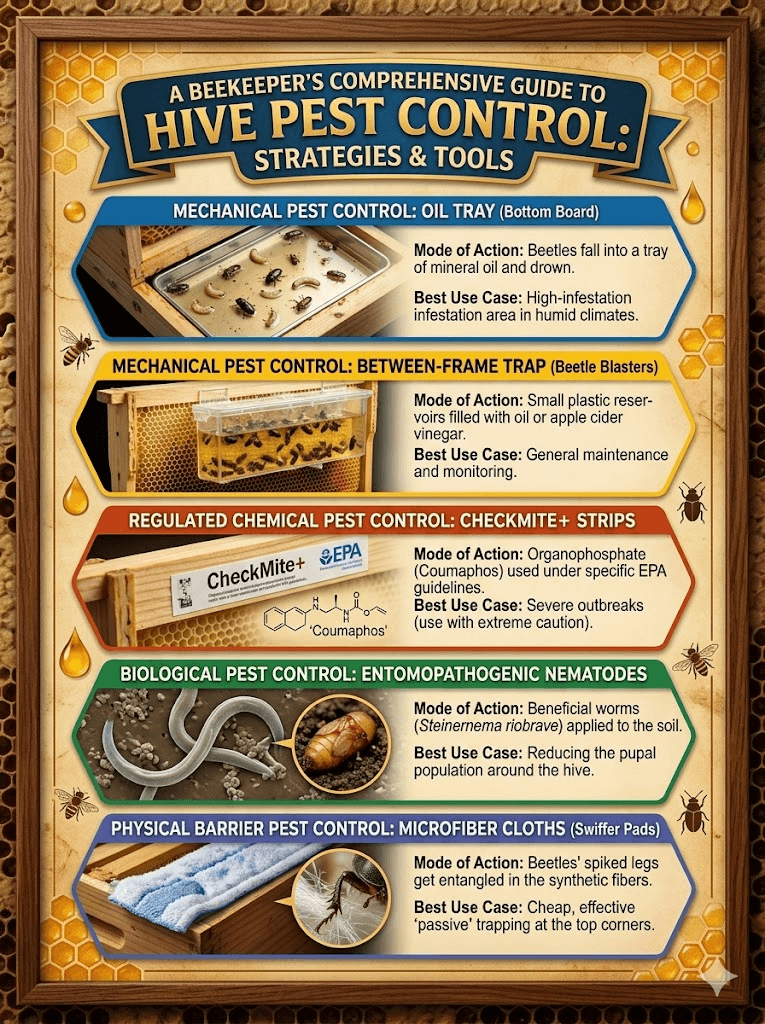
| Strategy Type | Tool/Method | Mode of Action | Best Use Case |
| Mechanical | Oil Trays (Bottom Board) | Beetles fall into a tray of mineral oil and drown. | High-infestation areas in humid climates. |
| Mechanical | Between-Frame Traps (Beetle Blasters) | Small plastic reservoirs filled with oil or apple cider vinegar. | General maintenance and monitoring. |
| Chemical (Regulated) | CheckMite+ Strips | Organophosphate (Coumaphos) used under specific EPA guidelines. | Severe outbreaks (use with extreme caution). |
| Biological | Entomopathogenic Nematodes | Beneficial worms (Steinernema riobrave) applied to the soil. | Reducing the pupating population around the hive. |
| Physical Barrier | Microfiber Cloths (Swiffer Pads) | Beetles’ spiked legs get entangled in the synthetic fibers. | Cheap, effective “passive” trapping in the top corners. |
Section 3: Honey House Hygiene – Preventing Post-Harvest Disasters
A unique challenge for American beekeepers, especially those running medium-to-large operations, is the “Honey House Slime-out.” Beetles are often brought into the extraction facility on the frames. In a warm, humid honey house, a few beetles can ruin thousands of dollars of honey in a single weekend.
The 48-Hour Rule
In the US climate, you should never leave supers unextracted for more than 48 hours unless they are kept in a temperature-controlled “Cold Room” (below 50°F / 10°C) or a room with humidity below 50%. Dehumidifiers are the secret weapon of the professional American beekeeper. By dropping the humidity in the honey house, you “dry out” the beetle eggs and prevent the Kodamaea yeast from fermenting the honey, effectively neutralizing the threat before extraction begins.
Section 4: The “Sunlight Defense” – Apiary Siting in North America
One of the most effective management tools is completely free: Solar Radiation. In Europe, beekeepers often place hives in dappled shade to protect from wind. In the SHB-heavy regions of the US, this is a mistake.
Studies from USDA research labs have shown that hives placed in full, direct sun have significantly lower beetle populations than those in the shade. The heat of the sun makes the hive interior less hospitable for the beetles, and the dry, baked earth in front of the hive makes it much harder for larvae to burrow and pupate. If you are beekeeping in a “Beetle Zone,” prioritize southern exposure and clear out any overhanging canopy.
Section 5: Genetic Resilience – Selecting for “Beetle-Cleaning” Behavior
Just as we breed for Varroa-Sensitive Hygiene (VSH), we are now seeing the emergence of “Beetle-Defensive” traits. Some lines of Italian and Carniolan bees in the US have developed a “jail-building” behavior. They will actively herd beetles into corners and “entomb” them with propolis walls.
As an agronomist, I look for queens that exhibit this aggressive social behavior. If I open a hive and see beetles running freely while the bees ignore them, that queen is marked for replacement. We need “policeman bees” that recognize the intruder and immediately initiate containment protocols.
Section 6: The Integrated Pest Management (IPM) Pyramid for SHB
To manage beetles in the US, you cannot rely on a single “silver bullet.” You must use a tiered approach:
- Cultural (Base): Proper hive siting (sunlight) and maintaining “strong-bee-to-comb” ratios. Never give a weak colony more comb than they can actively patrol.
- Physical (Middle): Using oil traps and microfiber sheets to remove adult beetles.
- Biological/Chemical (Top): Using soil nematodes or EPA-approved ground drench (GuardStar) if the soil population becomes critical.
Section 7: The “Tight-Box” Protocol – Eliminating Internal Refuges
In my years of managing both crops and colonies, I have learned that pests thrive in the “margins”—the overlooked gaps in a system. For the Small Hive Beetle, the standard Langstroth hive is often full of design flaws that provide safe havens from bee aggression. My “Tight-Box” protocol focuses on eliminating these structural refuges.
Most commercial hive bodies have slight tolerances that create 2-4mm gaps between the frame rests and the box walls. In a high-pressure beetle zone, these are not just gaps; they are “beetle bunkers.” I have moved toward a system of Precision Equipment Maintenance. Before the season starts, I inspect every super. If I find gaps that are too small for a bee to enter but large enough for a beetle to hide, I seal them with high-temp wood filler or propolis.
Furthermore, I have eliminated the use of “frame spacers” that create wide voids at the ends of the bars. By keeping the frames tightly squeezed together in the center of the box, I force the beetles to the periphery where I have my oil traps waiting. This management of “void space” is the difference between a controlled population and a sudden slime-out.
Section 8: Soil Physics and Larval Suppression – An Agronomist’s Strategy
Coming from a background in soil science and agronomy, I view the area around the hive as part of the pest management system. The SHB life cycle has a “choke point”: the pupation phase in the soil. If the soil environment is hostile, the beetle population cannot explode.
I employ a two-pronged soil strategy in my apiaries:
- Compaction and Barrier Zones: Beneath my hive stands, I remove all vegetation and implement a 4-inch layer of compacted crushed limestone or heavy gravel. Unlike soft, organic garden soil, compacted gravel is difficult for the “wandering larvae” to penetrate. Many larvae die of desiccation (drying out) before they can find a suitable spot to burrow.
- Targeted Moisture Control: SHB pupae require a specific moisture tension in the soil to survive. By ensuring my apiaries are located on well-drained, higher ground (avoiding the “bottom-land” dampness), I naturally lower the survival rate of the pupating beetles. In high-value breeding sites, I also apply Hydrated Lime to the soil surface twice a year. This raises the pH and creates a caustic environment that is lethal to soft-bodied larvae exiting the hive.
Section 9: The “Post-Harvest 24” – My Extraction Security Protocol
The most heartbreaking losses I have seen in the US occur not in the field, but in the honey house. As someone who manages digital systems and automation, I appreciate the need for strict “fail-safe” protocols. My honey extraction follows a rigid “Post-Harvest 24” rule.
In the humid American climate, SHB eggs on honey frames can hatch with terrifying speed. Once I pull supers, they are immediately moved into a dedicated “Dry Room.” This room is equipped with a high-capacity industrial dehumidifier and a heavy-duty floor fan.
- Humidity Target: 40-45%. At this level, the eggs of the beetle struggle to remain viable.
- Airflow: High-velocity air is circulated constantly. Beetles are attracted to the scent of “stressed” honey; by rapidly cooling and drying the air, we suppress the volatile signals that attract more beetles to the honey house.
- The 24-Hour Window: I aim to have all honey extracted and sealed in buckets within 24 hours of removal from the hive. If extraction is delayed, the frames are kept under constant UV light—beetles are photophobic (they hate light), and keeping the room brightly lit prevents them from congregating and laying eggs in the dark recesses of the supers.
The Architect of the Colony: A Masterclass in Queen Quality and Genetic Selection