The Synthetic Architecture of Nectar Transformation
Honey is often oversimplified as a natural sweetener, but from a molecular standpoint, it is a high-density, bio-synthetic fluid. The transformation of nectar into honey is a complex engineering process performed by the bee’s internal enzymatic laboratory. Unlike refined sugars, honey is a living matrix containing over 180 distinct chemical compounds, including enzymes, organic acids, minerals, and polyphenols. This complexity is what defines its “super-usefulness”—a synergy of physical and chemical barriers that create the most stable and therapeutic food source found in nature.
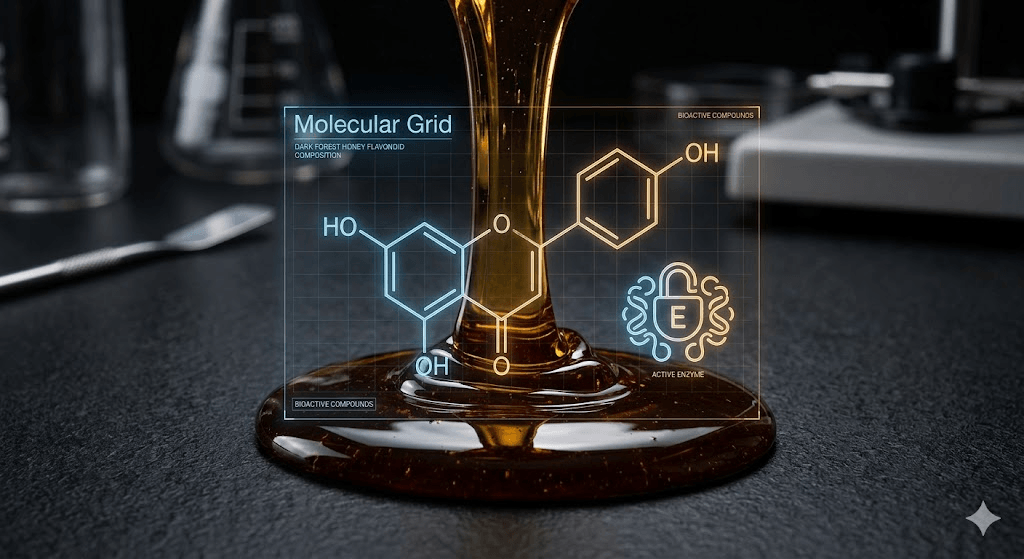
The Enzymatic Defense: Glucose Oxidase and the Peroxide Shield
The most remarkable technical feature of raw honey is its active antimicrobial system. When bees process nectar, they secrete the enzyme Glucose Oxidase. This enzyme acts as a catalyst, and when honey is diluted or consumed, it initiates a slow-release chemical reaction that produces Hydrogen Peroxide ($H_2O_2$).
This isn’t the harsh, high-concentration peroxide found in a pharmacy; it is a micro-dosed, persistent flow that provides a sterile environment without damaging human tissue. This “controlled release” mechanism is the reason honey has been used for millennia as a biological dressing. For the professional beekeeper, maintaining this enzymatic activity is the primary goal of a high-quality harvest. If honey is overheated or exposed to UV light, this “molecular shield” is permanently deactivated, turning a medicinal product into simple syrup.
The Foxats Bio-Active Quality Calibrator (HMF & Enzyme Stability)
To ensure the honey you harvest or sell remains in its “super-useful” state, you must monitor the degradation of its enzymes. This tool calculates the HMF (Hydroxymethylfurfural) accumulation and the Diastase Retention based on storage parameters.
Honey Therapeutic Index Calibrator
Predicted HMF Level: 8.4 mg/kg
Enzyme Potency (Diastase): 94%
Polyphenolic Synergy: The Antioxidant Network
Beyond enzymes, the “super-usefulness” of honey is driven by its polyphenolic index. These are secondary metabolites—flavonoids and phenolic acids—that bees collect from the plants. They serve as potent antioxidants, neutralizing free radicals in the human body. Darker honeys, like Buckwheat or Forest Honey, contain significantly higher concentrations of these compounds.
This isn’t just about nutrition; it’s about Bio-availability. Unlike synthetic vitamins, the antioxidants in honey are part of a complex matrix that the body can easily absorb and utilize. For an athlete or someone recovering from illness, honey acts as a “Biological Buffer,” reducing systemic inflammation and supporting mitochondrial function. When we look at the chemical fingerprints of monofloral honeys, we see a direct correlation between the soil chemistry of the forage area and the antioxidant capacity of the final product.
The Physics of Healing: Osmotic Pressure and pH Dynamics
The usefulness of honey extends into pure physics. Honey is a supersaturated solution with very low water activity ($a_w \approx 0.6$). This creates a high osmotic pressure—a physical force that literally draws water out of bacterial cells, causing them to collapse and die through dehydration.
Combine this with a low pH (typically between 3.2 and 4.5), and you have an environment that is too hostile for the majority of human pathogens. This physical engineering is why honey never spoils if kept in its high-density state. For the “Pro Tools” user, managing the moisture content of the harvest is the most important technical step. If moisture exceeds 18-19%, the osmotic pressure drops, yeast can survive, and the entire bio-chemical balance shifts from “Preservation” to “Fermentation.”
Honey as a Prebiotic: The Gut-Brain Axis Support
Recent data suggests that honey’s greatest benefit might be its role as a prebiotic. The unique oligosaccharides found in raw honey are not digested in the stomach; instead, they reach the colon where they serve as specialized fuel for beneficial bacteria like Bifidobacteria and Lactobacilli.
By modulating the gut microbiome, honey indirectly supports the immune system and the “Gut-Brain Axis.” This is “Precision Nutrition” at its finest. By choosing raw, unfiltered honey, you are delivering a targeted dose of complex sugars that regulate metabolic health. As we continue to bridge the gap between apiculture and data science, it becomes clear that honey is the ultimate functional food—an engineered outcome of millions of years of biological optimization.
Conclusion: The Professional Standard of Honey Quality
To maximize the “super-usefulness” of your harvest, you must treat honey with the respect its chemistry demands. This means minimal filtration to preserve pollen grains (the source of polyphenols) and strict temperature control to protect the enzymatic engine. Whether used as an antimicrobial agent, an antioxidant powerhouse, or a gut-health regulator, raw honey remains the gold standard of biological nutrition. On the Foxats platform, we advocate for this technical, data-driven understanding of our most precious harvest.
Hygroscopic Suction: The Physical Chemistry of Microbial Lysis
Honey is a masterclass in physical chemistry, specifically regarding its hygroscopic nature. With a water content typically below 18%, honey exists in a state of extreme thirst. This is not merely a storage characteristic; it is an active mechanical weapon. When a bacterial cell comes into contact with raw honey, it encounters a massive osmotic gradient. The honey’s low water activity ($a_w \approx 0.60$) exerts a powerful “suction” force, pulling water out of the bacterial cell through its semi-permeable membrane.
This process, known as plasmolysis, causes the cellular structure of the pathogen to collapse. The bacteria effectively “dehydrate” to death in a matter of minutes. For the professional beekeeper, managing this hygroscopic potential is a high-stakes balancing act. If the honey’s moisture content rises above 19%, the osmotic pressure drops significantly, crossing the threshold where osmophilic yeasts can survive and begin fermentation. Maintaining a high “Hygroscopic Index” is the primary physical barrier that ensures honey remains the only non-perishable biological fluid in the world.
The Melissopalynological Data Packet: Pollen as a Bio-Chemical Marker
Every drop of raw honey contains thousands of microscopic “data packets” known as pollen grains. Melissopalynology—the study of pollen in honey—is the key to bio-traceability and therapeutic standardization. These grains are not just contaminants; they are the primary source of the honey’s amino acid profile and mineral density. From an engineering perspective, pollen acts as a biological fingerprint that verifies the monofloral purity and geographical origin of the product.
Beyond traceability, pollen contributes to the “Phytochemical Loading” of the honey. Each grain carries a specific set of plant secondary metabolites—alkaloids, glycosides, and terpenes—that are released into the honey matrix during the ripening process. When we perform fine-mesh filtration (common in industrial processing), we strip the honey of these data packets, effectively “deleting” its medicinal potential. A high-performance apiary prioritizes gravity-fed settling over pressure filtration to preserve the integrity of this pollen matrix, ensuring that the final product retains its full spectrum of bio-active markers.
The Saturation Index: Controlling Crystallization Through Fructose-to-Glucose Ratios
Crystallization is often misunderstood as spoilage, but it is actually a predictable thermodynamic phase transition. Honey is a supersaturated solution, meaning it holds more dissolved solids (sugars) than the liquid should theoretically allow. The stability of this liquid state is governed by the $F/G$ ratio (Fructose-to-Glucose). Glucose is less soluble than fructose and serves as the primary seed for crystal formation.
When the $F/G$ ratio is low (e.g., in rapeseed or sunflower honey), crystallization occurs rapidly, sometimes within days of harvest. Conversely, honeys with a high $F/G$ ratio (e.g., acacia) can remain liquid for years. For the “Pro Tools” user, managing this texture is an engineering challenge. By calculating the Saturation Index ($\frac{G-W}{L}$, where $W$ is water and $L$ is levulose/fructose), we can predict the shelf-life and texture of the honey. To prevent coarse, jagged crystals that ruin the “mouthfeel,” we can induce “Fine-Grain Controlled Crystallization” by seeding the honey with microscopic glucose crystals and maintaining a steady temperature of $14^\circ C$. This allows us to engineer a “Creamed Honey” that is biologically stable without ever applying the damaging heat of pasteurization.
The Gut-Brain Axis: Honey’s Oligosaccharides as Precision Prebiotics
While the glucose and fructose in honey provide immediate metabolic fuel, it is the rare oligosaccharides (complex sugars) that provide the long-term therapeutic benefit. These compounds, such as melezitose and erlose, are not broken down by human digestive enzymes. Instead, they travel deep into the lower gastrointestinal tract, where they act as precision prebiotics. They serve as a specialized growth medium for beneficial Bifidobacteria and Lactobacilli.
This modulation of the gut microbiome has a direct impact on the “Gut-Brain Axis,” influencing systemic inflammation and immune response. Unlike refined prebiotic supplements, the oligosaccharides in honey are delivered in a polyphenolic-rich matrix that protects them from premature degradation. From an engineering standpoint, consuming raw honey is equivalent to “reprogramming” the gut’s biological software. By providing the specific substrates required for healthy microbial fermentation, honey supports the production of Short-Chain Fatty Acids (SCFAs), which are critical for maintaining the integrity of the intestinal lining and reducing oxidative stress throughout the body.
Bio-Active Standardization: Moving Toward Medical-Grade Honey Protocols
The future of the professional apiary lies in Bio-Active Standardization. Currently, the market is dominated by “Manuka” honey due to its high Methylglyoxal (MGO) content, but many local honeys possess equivalent or superior bio-activity through the “Peroxide Pathway” and “Phenolic Loading.” To compete at a professional level, we must adopt standardized metrics for measuring quality beyond simple moisture and color.
This involves quantifying the Diastase Number (DN) and the Invertase Activity. These enzymes are the most heat-sensitive components of honey; their presence is a “Thermal History” certificate. A high DN confirms that the honey has never been exposed to temperatures above $40^\circ C$, preserving its bio-active essence. Furthermore, by measuring the Total Antioxidant Capacity (TAC), we can assign a “Therapeutic Grade” to our harvest. By moving toward these data-driven standards, we transform honey from a commodity into a precision-engineered wellness tool. The goal is to provide a product that is not just “sweet,” but “biologically certified” to deliver the molecular benefits discussed in this matrix.