Introduction: The Agronomic Approach to Apiary Nutrition
In my 15 years as an agronomist, I have treated soil fertility as a balance sheet of chemical inputs and biological outputs. Beekeeping is no different. The transition from winter dormancy to spring expansion is not merely a biological phase; it is a high-stakes energy conversion process. To scale a colony efficiently, we must move beyond “feeding sugar” and start “engineering nutrition.” This article explores the bio-chemical requirements of the honeybee colony and introduces a precision tool to calculate the nutritional deficit during critical expansion periods.
The Bio-chemical Foundations of Royal Jelly Production
The growth of a honeybee colony is limited by the availability of high-quality protein. Vitellogenin, the precursor to royal jelly, is synthesized in the fat bodies of nurse bees. However, the conversion rate of external pollen into internal protein reserves is highly dependent on the amino acid profile of the source.
As an agronomist, I compare pollen to a fertilizer mix. If one essential amino acid (like Isoleucine or Valine) is missing, the entire “nutritional engine” stalls. In early spring, or during periods of environmental stress, the colony often faces a “Protein Gap.” By using a Protein Bio-availability Index, we can determine the efficiency of artificial substitutes compared to natural floral sources. My research suggests that many commercial substitutes fail because they lack the necessary lipid-to-protein ratio required for sustained brood pheromone production.
The Energy Economics of Early Spring Brood Expansion
Brood rearing is the most energy-intensive activity in the hive. Maintaining a constant temperature of $35^\circ C$ ($95^\circ F$) within the brood nest requires an exponential increase in carbohydrate consumption as the ambient temperature drops.
When a colony expands its brood nest in March or April, it operates on a razor-thin margin. For every additional frame of brood, the caloric requirement of the colony increases by approximately 15-20%. Without precise calculation, beekeepers often face “starvation in the midst of plenty,” where the bees have honey but cannot leave the brood to reach it due to cold. This is where the Energy Economics Calibrator becomes indispensable.
The Foxats Nutrition & Energy Calibrator
This tool calculates the estimated daily honey consumption and protein requirement based on the number of brood frames and the average ambient temperature.
Nutrition & Energy Calibrator
Est. Daily Honey Consumption: 250 g
Est. Daily Pollen Requirement: 120 g
Amino Acid Profiling: The Limiting Factor in Protein Substitutes
In my agronomic work, we follow “Liebig’s Law of the Minimum,” which states that growth is dictated not by total resources available, but by the scarcest resource (limiting factor). For a honeybee, if the pollen substitute is high in protein but low in Leucine, the nurse bees cannot synthesize the necessary quantity of larval food.
When engineering your own protein patties, you must look for ingredients that mimic the amino acid profile of willow or fruit tree pollen. In my apiary, I have experimented with fermented soy-yeast blends that increase the bio-availability of these proteins by breaking down complex starches into simple sugars and peptides. This “pre-digestion” process allows the bees to allocate more energy to brood warming rather than digestion.
Integrating IoT: Real-Time Monitoring of Nutritional Stress
As a Python programmer and IoT enthusiast, I see the potential for using weight scales and internal humidity sensors (ESP32-based) to detect nutritional stress before it becomes visible. A sudden drop in hive weight during a cold snap is the first indicator of high metabolic honey consumption.
By integrating the Foxats Nutrition Calibrator with live data from an ESP32, we can build an automated dashboard that predicts when a colony will run out of stores. This is the future of beekeeping—where data science and agronomical experience converge to ensure the survival of our pollinators.
Conclusion: Precision Management for Sustainable Apiaries
Understanding the nutrition of the hive is as vital as understanding the chemistry of the soil. By calculating the energy cost of survival and the protein requirements for growth, we move from being “bee keepers” to “colony engineers.” The tools provided here on Foxats are designed to give you that edge, combining years of field experience with modern computational power.
Lipid Dynamics: The Fuel Cell of the Honeybee Fat Body
In my years of studying soil science, we often focused on the organic matter as the “battery” of the field. In the honeybee, this battery is the fat body. While protein is the building block for muscles and royal jelly, lipids (fats) are the primary energy storage and regulatory organs. For a colony expanding in early spring, lipid reserves are the “fuel cells” that power the nurse bees. If a nurse bee has depleted lipid stores, she cannot sustain the high metabolic heat required to keep the brood at a constant $35^\circ C$.
From an engineering perspective, we can view lipid metabolism as a thermal management system. Bees convert carbohydrates from honey into long-chain fatty acids stored in their abdomen. During a cold snap, these lipids are “burned” to generate heat. However, there is a technical limit: if the diet lacks essential sterols (like 24-methylenecholesterol), the bee’s cellular membranes become brittle, and her lifespan shortens. In my apiary, I analyze the lipid-to-protein ratio of my supplements with the same scrutiny I use for N-P-K ratios in fertilizers. A high-protein patty without a balanced lipid profile is like a high-horsepower engine with a tiny fuel tank—it will fail just when the demand is highest.
Micronutrient Synergy: Beyond N-P-K in Apiary Nutrition
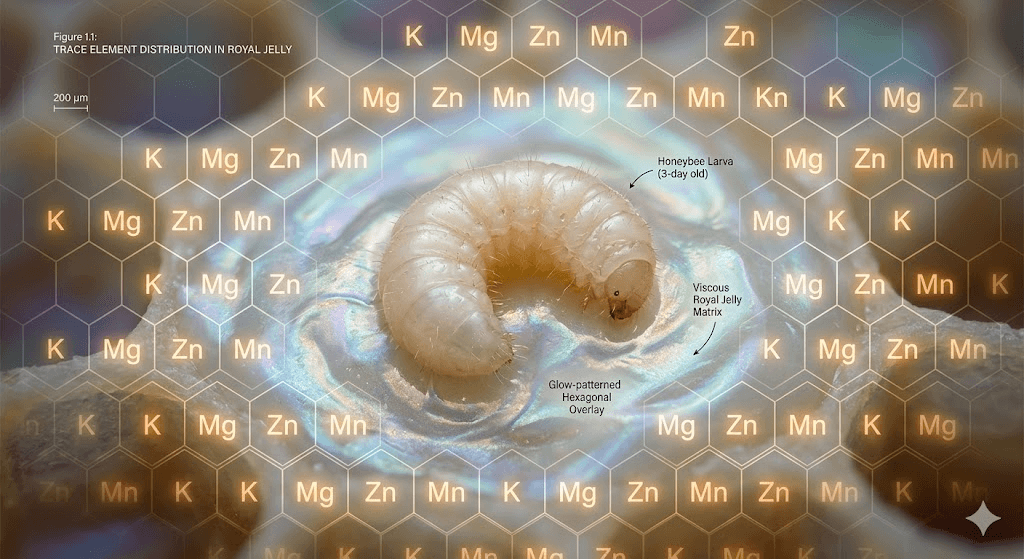
In agronomy, we know that a lack of Boron or Zinc can ruin a harvest, even if Nitrogen levels are perfect. This is the “Law of the Minimum” in action. In the beehive, we often obsess over sugar and protein, but we neglect the micro-minerals: Potassium, Magnesium, and Manganese. These elements act as catalysts for the enzymatic reactions that turn pollen into bee bread. Without these micronutrients, the larvae suffer from “silent hunger”—they grow, but their immune systems are compromised.
When I design a nutritional protocol, I look for the synergy between these elements. For example, the absorption of certain proteins is linked to the presence of specific B-complex vitamins. Natural pollen is a complex matrix of these elements, but artificial substitutes often miss the mark. By calculating the “Micronutrient Density” of the forage available around your apiary, you can predict periods of nutritional stress. I use my Python-based data models to map the blooming periods of local flora against the known mineral profiles of their pollen. This allows me to “bridge the gap” with targeted mineral supplements, ensuring that the colony’s “biochemical soil” is always fertile.
Phytochemical Priming: The Bio-active Defense Layer
The most advanced frontier in apiary nutrition is the study of phytochemicals—non-nutritive compounds like polyphenols and flavonoids found in nectar and pollen. As an agronomist, I see these as the “immune system” of the plant that is passed on to the bee. These compounds are not “food” in the caloric sense, but they act as biological triggers that prime the bee’s detoxification pathways.
When bees are fed purely on sucrose or low-quality substitutes, they miss out on these bio-active molecules. This makes them more susceptible to pesticides and viruses. It is similar to a crop that has been grown in sterile soil—it might look healthy, but it lacks the natural resilience to withstand pests. In my research, I have found that adding specific plant extracts (like thymol or certain tannins) to spring feed can simulate this natural “priming” effect. This is “Engineering for Immunity.” By understanding the chemical signals that plants send to bees, we can optimize our feeding programs to not only grow more bees but to grow stronger bees that are biologically prepared for the challenges of the foraging season.