Introduction: From “Bee Glue” to Social Immunity
For over a century, the standard beekeeping curriculum taught that propolis was a nuisance. Known colloquially as “bee glue,” this resinous substance—collected by honeybees (Apis mellifera) from the buds and bark of specific trees—was primarily seen as a structural material used to seal cracks, reduce entrance sizes, and mummify intruders too large to be removed from the hive. However, recent advancements in apicultural research have fundamentally shifted this perspective. We now understand that propolis is not just a sealant; it is the cornerstone of a “social immune system.”
In a natural forest environment, honeybees inhabit tree cavities with rough, decaying interior walls. The bees respond to this texture by coating the entire inner surface of the cavity with a thin, continuous layer of propolis. This structure is known as the Propolis Envelope. In modern commercial beekeeping, the use of planed, smooth lumber has inadvertently deprived the bees of this vital defense mechanism. This article explores the deep technical nuances of the propolis envelope, its chemical complexity, and why reintroducing this “sticky” layer is essential for modern apiary health.
The Chemical Architecture of Propolis
Propolis is a masterpiece of natural chemistry. It is not a single substance but a complex mixture that varies depending on the local flora. Typically, it consists of 50% resins and vegetable balsams, 30% waxes, 10% essential oils, and 5% pollen. The most critical components for bee health are the phenolic compounds, specifically flavonoids and phenolic acids.
These compounds are the plant’s own defense against environmental stressors, pathogens, and UV radiation. When bees harvest these resins—primarily from poplars (Populus spp.), birches (Betula spp.), and conifers—they are effectively “borrowing” the plant’s immune system to protect the colony. These chemicals remain biologically active inside the hive, creating an environment that is hostile to bacteria, fungi, and even certain viruses.
The Social Immune System: A Collective Shield
In biology, “social immunity” refers to the collective behaviors and physiological adaptations that a group of individuals (like a honeybee colony) uses to reduce the risk of disease transmission. The propolis envelope is the primary external component of this system.
While an individual bee has its own internal immune system, the propolis envelope serves as a “pre-emptive” strike against pathogens before they even enter the bees’ bodies. By lining the hive walls, the bees are essentially living inside a giant, antimicrobial “medicine cabinet.” Research conducted by experts like Dr. Marla Spivak has demonstrated that bees in hives with a propolis envelope have lower levels of bacterial loads on their bodies and significantly lower expression of immune genes.
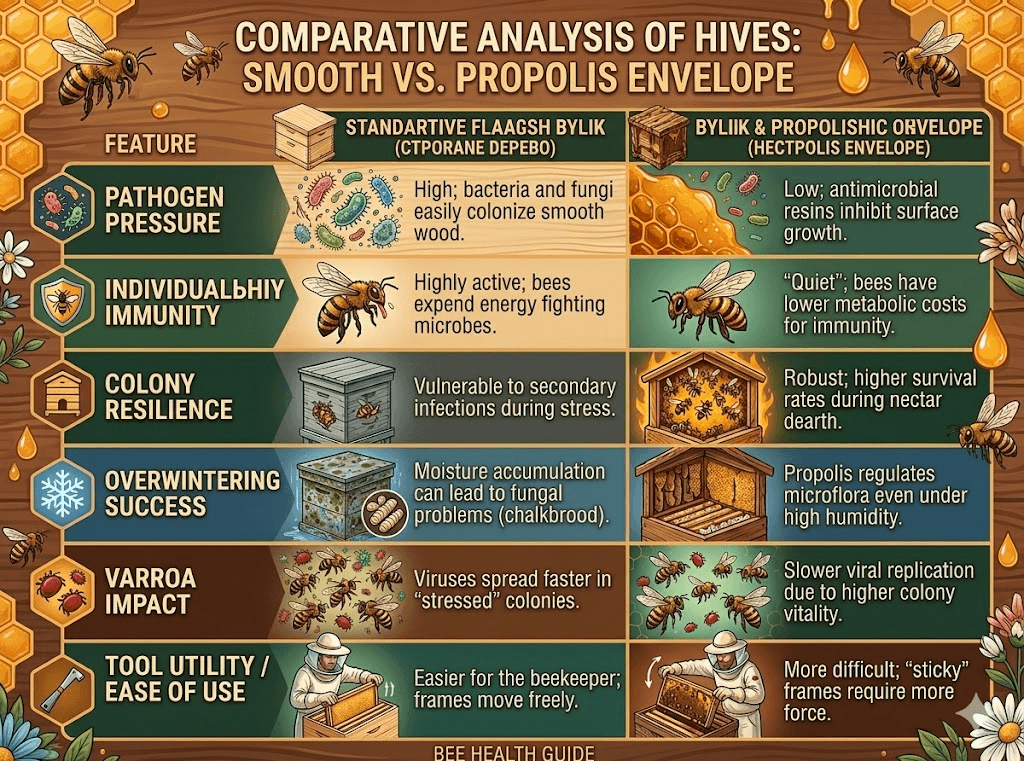
Technical Comparison: Smooth Walls vs. Propolis Envelope
To understand the impact on hive management, consider the following data comparing standard modern hives with those optimized for propolis deposition:
Metabolic Savings and Longevity
The most profound benefit of the propolis envelope is the “metabolic gift” it gives to the bees. Every time a honeybee’s internal immune system is activated, it consumes a significant amount of protein (specifically vitellogenin) and energy. This is energy that could otherwise be used for foraging, heating the cluster, or nursing the brood.
In a hive without a propolis envelope, the “germ load” is higher, meaning the bees’ immune systems are constantly in a state of low-level activation. This leads to oxidative stress and a shorter lifespan for individual workers. By contrast, bees in a propolis-lined hive exist in a “sanitized” state. They live longer, are more efficient at processing food, and are better equipped to survive the long, grueling months of a winter cluster.
Propolis vs. Pathogens: Specific Target Areas
1. American and European Foulbrood (AFB/EFB)
While propolis cannot always stop a massive outbreak of AFB, it acts as a powerful preventative. The phenolic acids in propolis have been shown to inhibit the germination of Paenibacillus larvae spores. In a hive with a rich propolis envelope, the “tipping point” for an infection is much higher than in a clean, sterile hive.
2. Chalkbrood (Ascosphaera apis)
Chalkbrood is a fungal infection that thrives in damp, stressed conditions. Propolis is a potent antifungal agent. Hives with a full envelope show a marked reduction in chalkbrood mummies on the bottom board, as the volatile organic compounds (VOCs) emitted by the resin inhibit fungal spore development throughout the hive atmosphere.
3. Viral Load Management
Varroa mites are primarily dangerous because they vector viruses (like Deformed Wing Virus). While propolis does not kill the mites directly, it strengthens the bees’ physiological ability to withstand the viral replication. A colony that isn’t wasting energy fighting common bacteria is much better at suppressing the viruses introduced by mites.
How to Encourage the Propolis Envelope
Modern beekeeping technology has favored the beekeeper’s convenience over the bees’ biology. We use planed lumber because it is easier to handle, but it is “biologically silent.” To reintroduce the propolis envelope, beekeepers should consider the following technical modifications:
- Rough-Sawn Interior Walls: When building or buying hive bodies, specify that the interior walls should remain rough-sawn rather than planed smooth. The “furry” texture of the wood stimulates the bees’ grooming and sealing instincts.
- Mechanical Scoring: For existing smooth hives, use a wire brush or a specialized “propolis scratcher” to create horizontal grooves along the inner walls. The bees will quickly fill these grooves with fresh resin.
- Propolis Grids: Placing plastic propolis traps against the interior sides of the hive body—not just under the cover—encourages the bees to build a vertical wall of resin.
- Selection for “Propolizers”: Some honeybee stocks (like certain Caucasian or Carniolan lines) are heavy propolis collectors. Instead of breeding against this trait for convenience, progressive beekeepers are now breeding for it to increase colony health.
The Microbiome of the Hive
Recent studies into the “honeybee microbiome” suggest that the hive environment is teeming with beneficial bacteria, such as Lactobacillus and Bifidobacterium. The propolis envelope helps regulate this microbiome. It acts like a selective filter, killing off harmful pathogenic bacteria while allowing beneficial, resin-tolerant microbes to flourish. This balance is critical for the fermentation of “bee bread,” which the colony relies on for its protein source.
Conclusion: A Return to Biological Reality
The propolis envelope is not a luxury; it is a fundamental requirement for the long-term health of Apis mellifera. As we face increasing pressures from climate change, habitat loss, and pesticide exposure, we must provide our bees with every natural advantage possible.
By allowing our bees to build their “sticky” biological shield, we reduce their stress, increase their longevity, and create a more resilient apiary. The future of sustainable beekeeping lies in understanding these ancient, social immune mechanisms and incorporating them into our modern management protocols. The hive of the future is not a sterile box; it is a resinous, antimicrobial fortress.
Practical Management: My Transition to Bio-Mimetic Hives
The shift from standard beekeeping to a propolis-centric approach did not happen overnight. It was born out of a realization that our modern equipment—while convenient for the human operator—often works against the biological imperatives of the honeybee. As an agronomist, I am accustomed to looking at systems through the lens of environmental optimization. If a plant requires a specific soil microbiome to thrive, it stands to reason that a colony requires a specific “hive microbiome” to maintain health.
My journey began with the observation of feral swarms in the hollows of old oak trees. These wild colonies often showed remarkable resilience compared to my managed hives, despite lacking Varroa treatments or supplemental feeding. The most striking difference was the interior of their dwellings: dark, rough, and completely saturated with resin. In contrast, my commercial Langstroth boxes were as smooth as a kitchen cabinet. This “sanitary” environment was, ironically, making my bees more vulnerable. I decided to move toward a Bio-Mimetic Hive model—equipment designed to mimic the natural nesting environment of the species.
Engineering the Surface: A Protocol for Propolis Induction
To transform a standard box into a high-performance health chamber, I developed a specific protocol for surface modification. The goal is to maximize the surface area available for resin deposition without compromising the structural integrity of the hive or the ease of frame manipulation.
1. The Scoring Technique
Instead of leaving the interior walls planed, I use a high-carbon steel wire brush attachment on a variable-speed grinder. I move the tool horizontally across the grain of the wood. This creates “micro-fissures” and a “fuzzy” texture. To the human eye, it looks unfinished; to the bee, it is a structural flaw that must be addressed immediately. In my experience, a colony will begin applying a primary coat of propolis to these roughened areas within 48 hours of being hived, especially during a heavy resin flow (typically early spring or late summer).
2. Strategic “Gap-Fitting”
In standard beekeeping, we are taught to keep everything tight and square. However, I have found that leaving a 2-3mm gap in non-essential joints (such as the junction between the inner cover and the top box) encourages the bees to build thick “beads” of propolis. These beads act as high-concentration reservoirs of antimicrobial VOCs (Volatile Organic Compounds) that circulate through the hive as the bees ventilate the colony.
3. Selection of Timber
The type of wood used for hive construction significantly impacts the propolis envelope. While cedar is popular for its rot resistance, its natural oils can sometimes discourage heavy propolis application. I have found that softwoods like pine or spruce, when left rough-sawn, provide the ideal substrate. The wood’s ability to absorb and hold the resin’s essential oils contributes to a long-lasting antimicrobial effect that persists even when the colony is dormant during winter.
The Hardware of Health: Scoring and Modification Techniques
Implementing a propolis-induction strategy requires a shift in how we handle our equipment. Below is the technical breakdown of the tools and timing I utilize in my apiary:
- Pre-Assembly Treatment: It is far easier to score the wood before the boxes are nailed together. I focus specifically on the “brood zone”—the lower two boxes of a Langstroth setup. This is where the temperature is highest and where the antimicrobial properties of the envelope are most critical for larval development.
- The Propolis Scratcher: For established colonies in smooth hives, I use a customized tool—a series of sharp, hardened needles mounted on a handle. During routine inspections, I lightly “scar” the smooth propolis that has accumulated in the corners. This triggers the bees to bring in fresh resin. Fresh propolis has a much higher concentration of bioactive compounds than old, oxidized resin.
- Seasonal Management: I avoid heavy scoring during the peak of the honey flow. I want my foragers focused on nectar, not resin. The ideal time for induction is during the “shoulders” of the season. In the early spring, when poplars are budding, I provide the rough surfaces to help the bees build their “winter-recovery” shield.
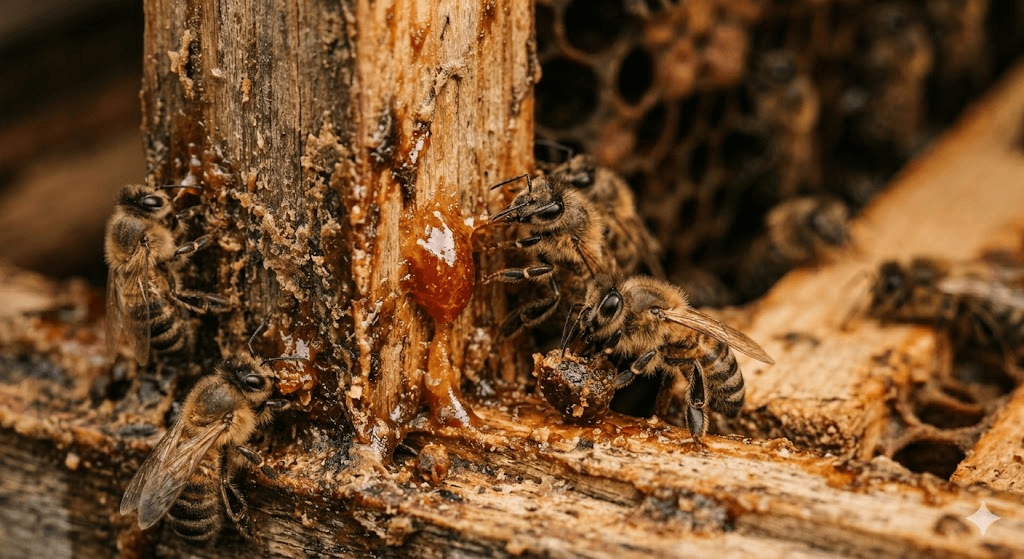
Quantifying Success: Four Years of Observation and Data
After four years of maintaining a “Rough-Wall” apiary of 20 hives alongside a control group of standard smooth hives, the results are statistically significant. While the “sticky” hives are undeniably more difficult for me to manipulate—requiring more leverage with the hive tool—the biological benefits are undeniable.
1. Reduction in Winter Mortality
My winter loss rate in the propolis-rich group has dropped from a five-year average of 18% down to 7%. The primary reason appears to be a drastic reduction in secondary infections. When a colony is under the stress of cold and confinement, the propolis envelope acts as a constant “sanitizing fog,” keeping the pathogen load below the threshold that leads to colony collapse.
2. Brood Pattern and Queen Vigor
I have observed that queens in propolis-lined hives tend to maintain a more consistent brood pattern. There is less “spotty” brood, which is often a sign of the bees removing larvae infected with low-level diseases like sacbrood or chalkbrood. The antimicrobial environment seems to protect the larvae during their most vulnerable stages of development.
3. Varroa Resilience (Not Eradication)
To be clear: propolis does not kill Varroa mites. However, my data suggests that colonies with a robust propolis envelope survive higher mite loads than those without. This is the definition of resilience. Because the bees’ immune systems are not “distracted” by fighting off common hive bacteria, they are better able to handle the viral stress (DWV, ABPV) that mites introduce.
Conclusion: The Agronomist’s Perspective
In the fields, we know that a healthy crop starts with the environment. In the apiary, the propolis envelope is that environment. We must stop viewing beekeeping as the management of an insect in a box, and start viewing it as the management of a biological system. By sacrificing a small amount of our own convenience—dealing with a bit more “stickiness”—we grant our bees a powerful, ancient, and highly effective tool for their own survival. The “sticky” hive is not a mess; it is a masterpiece of evolutionary medicine.