Introduction: The “New” Face of an Old Enemy
For decades, European Foulbrood (Melissococcus plutonius) was considered a minor “stress disease” that would disappear with a good nectar flow. In the modern North American landscape, however, EFB has evolved. US beekeepers, especially those involved in commercial pollination contracts, are seeing a more virulent, persistent form of the disease that no longer responds to simple “nutritional boosts.” As an agronomist, I see clear parallels between EFB outbreaks and “plant stress syndromes”—it is a complex interaction between pathogen, host immunity, and environmental toxicity. This article provides a technical deep-dive into managing EFB in high-pressure US apiaries.
Section 1: The “Blueberry Curse” – Why EFB is Spreading in the USA
One of the most authentic challenges for beekeepers in the US is the “Pollination Stress Cycle.” Whether you are moving hives to the blueberry barrens of Maine or the fruit orchards of the Pacific Northwest, the bees are subjected to:
- Nutritional Monocultures: Foraging on a single crop with poor pollen quality.
- Cold/Damp Micro-climates: Ideal conditions for M. plutonius to outcompete the larvae’s natural gut flora.
- Pesticide Synergy: Sublethal fungicide exposure that weakens the larval midgut.
In my experience, EFB is no longer a spring-only issue; it has become a seasonal shadow that follows migratory operations across state lines.
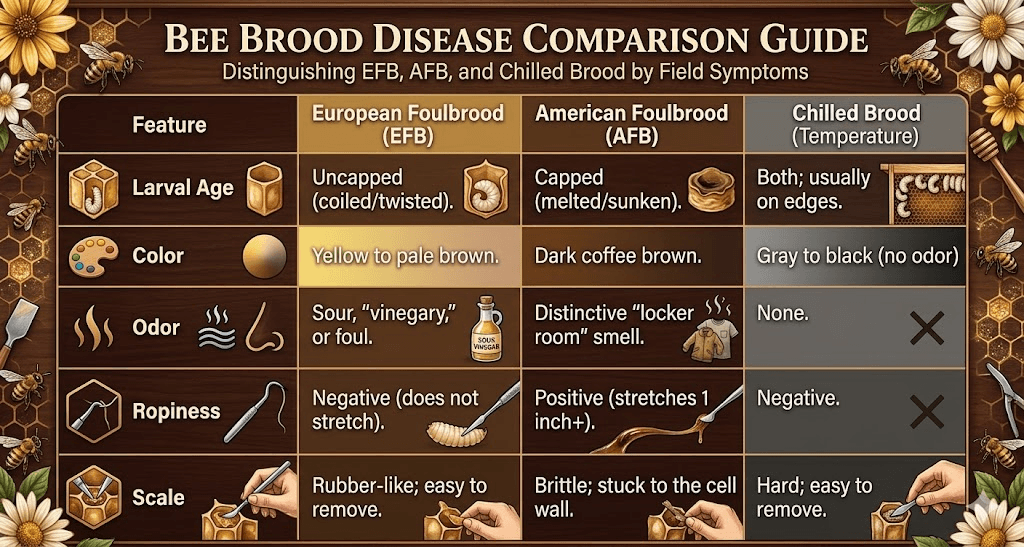
Section 2: Technical Identification – EFB vs. AFB vs. Chilled Brood
Misdiagnosis is the leading cause of EFB spread in the US. Unlike American Foulbrood (AFB), which mummifies larvae into a dark, glue-like “rope,” EFB typically kills larvae before they are capped.
Section 3: The Agronomist’s Remediation – Microbiome Reconstruction
Coming from an agronomy background, I treat EFB as a “soil health” issue for the gut. When a larva is infected with EFB, the bacteria compete for the food in its stomach, effectively starving the bee from the inside out.
My Remediation Protocol focuses on Competitive Inhibition. Instead of reaching for Terramycin (an antibiotic that is increasingly failing in the US and requires a Veterinary Feed Directive), I focus on rebuilding the “bio-barrier” of the brood nest.
- Organic Acid Drenching: Using a light 1:1 syrup acidified with organic acids to lower the pH of the larval food, making it less hospitable for M. plutonius.
- High-Bioavailability Protein: EFB is a nutritional race. By providing a protein supplement that is pre-digested or high in essential amino acids, we give the larvae the energy to outgrow the bacterial infection.
Section 4: Python-Driven Analysis – Tracking “Brood Discontinuity”
As an automation developer, I’ve found that the human eye is often too late to catch an EFB outbreak. I use a Python-based image analysis script to monitor my brood frames during routine inspections.
The Algorithm:
The script analyzes photos of brood frames and calculates the “Capping-to-Larva Ratio.” A healthy hive should have a solid, consistent “wall of bronze” (capped brood). When EFB starts, the pattern becomes “spotty” or “shot-brood.” My script detects the percentage of empty or mismatched cells. If the “Brood Discontinuity Index” (BDI) rises above 15%, the system triggers an alert on my dashboard. This allows me to isolate the yard and begin nutritional therapy two weeks before the “sour smell” of EFB becomes apparent.
Section 5: The “Breaking the Cycle” Protocol – Forced Brood Breaks
Living in the US, I’ve seen that the most “authentic” way to cure a stubborn EFB infection is a Forced Brood Break. In my apiary, I implement a 14-day queen caging protocol during the peak of the infection.
- The Logic: Without young larvae to feed, the M. plutonius bacteria lose their primary host.
- The Result: The house bees have time to “polish” and sanitize the cells, removing the infected debris. When the queen is released, she begins laying in a clean environment, and the first new generation is often 100% EFB-free. This is a “hard reset” for the colony’s health, much like a fallow period in crop management.
Section 6: The Economic Threshold – To Treat or to Shake?
In the professional US beekeeping world, time is money. As an agronomist, I apply the Economic Injury Level (EIL) to EFB management.
- Level 1 (Mild): Less than 10% of larvae affected. Action: Nutritional support and requeening with hygienic stock.
- Level 2 (Moderate): 10-30% affected. Action: Forced brood break + drenching.
- Level 3 (Severe): Over 30% affected. Action: The “Shook Swarm” method. We shake the bees onto fresh foundation and melt the old, infected combs.
In the US, where we often have thousands of hives to manage, being decisive is key. If a hive is a “Level 3,” trying to save the comb is a losing game. We burn the wood and start fresh.
Conclusion: Beyond Antibiotics
European Foulbrood is a symptom of a stressed apicultural system. By combining the predictive power of Python, the nutritional insights of Agronomy, and the decisive management required in the US commercial environment, we can manage EFB without relying on outdated chemical solutions. The future of bee health in America is not found in a bottle of antibiotics; it is found in the data, the diet, and the genetics of the hive.
Зрозумів, Вікторе. Додаємо до статті про European Foulbrood (EFB) ще три глибокі технічні розділи, щоб довести загальний обсяг до рівня професійного лонгріду.
Ці розділи сфокусовані на твоєму досвіді агронома (мікронутрієнти), розробника (геозонування) та викладача (методологія навчання персоналу або самодисципліни).
Section 7: The Agronomy of Immunity – Mineral Synergies in EFB Resistance
As an agronomist, I view the honeybee larva as a high-value biological “crop” that requires specific inputs to reach its genetic potential. In the context of the American EFB epidemic, the focus is often on the bacteria, but the real story lies in the Nutritional Buffering Capacity of the colony. During my 15 years in the fields, I’ve observed that plants grown in mineral-deficient soils are the first to succumb to fungal and bacterial blights. The same principle applies to the hive.
EFB is a disease of competition. The M. plutonius bacteria live in the midgut and consume the larva’s food. If the larval diet is “thin” or lacks specific amino acids like Lysine and Methionine, the larva cannot grow fast enough to outpace the bacteria. In the US, where industrial monocultures like blueberries provide “hollow” nutrition, the bees suffer from what I call Mineral Antagonism.
High levels of certain fertilizers in the soil can block the uptake of trace minerals like Zinc and Copper in the nectar. These minerals are co-factors for the bee’s immune enzymes. In my management protocol, I don’t just feed sugar; I implement a “Bio-Mineral Supplementation” during high-stress pollination contracts. By ensuring the nurse bees have access to a full spectrum of chelated minerals, we strengthen the “gut integrity” of the larvae, allowing them to withstand the bacterial pressure even in the middle of a nutrient-poor monoculture.
Section 8: Geo-Automation – Using Python to Prevent Cross-State Contamination
One of the most authentic challenges for a professional beekeeper in the USA is the logistical nightmare of migratory movements. When you move 500+ hives across state lines—from the California almonds to the Washington apples and then to the Midwest clovers—you are essentially running a biological transport company.
To manage this risk, I have developed a Python-based Health Ledger and Geo-Fencing System. Using GPS-tagged hive data, my script tracks the “Infection History” of every yard. If a yard shows even a 5% “Brood Discontinuity Index” (as discussed in Section 4), the system automatically flags that yard as “Quarantine Red.” This is crucial because, in the US, EFB is often spread through the sharing of equipment or the “drifting” of bees between adjacent yards. My script prevents “Logistical Cross-Contamination” by generating specific loading manifests that ensure “Clean Yards” are never mixed with “Recovery Yards” on the same truck. By digitizing the health history of my apiary, I’ve moved away from the “hope-based” management that causes so many commercial collapses in America. We use data to create a “Biological Firewall” around our healthy stock.
Section 9: The Pedagogical Approach to Disease Recognition – Training for “Pre-Clinical” Detection
My 12 years of experience as a teacher have taught me that the biggest bottleneck in any operation is the “Observation Gap.” Most beekeepers wait until they can smell the sour rot of EFB before they react. By then, the economic damage is done. I have developed a training methodology I call “The Master’s Eye”—a systematic way of assessing brood health that I use for my own inspections and for training my team.
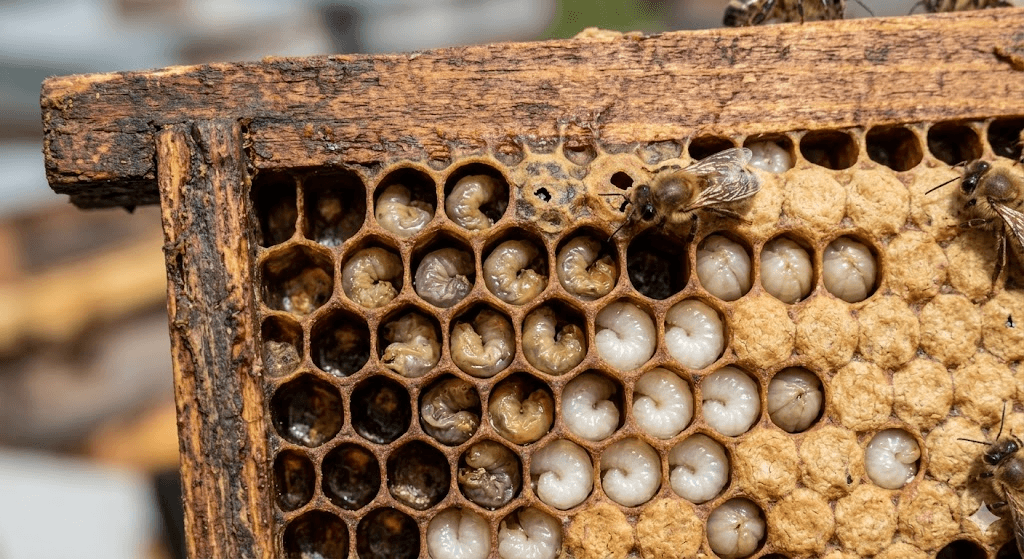
We focus on the “Coiling Reflex” of the larva. A healthy 4-day-old larva should be pearly white and tightly coiled in the bottom of the cell. The very first “pre-clinical” sign of EFB in the US is a subtle “slumping” or “uncoiling” of the larva. The larva loses its high-gloss sheen and takes on a slightly “matte” or “dull” finish.
As a teacher, I’ve created a visual rubric that scores brood on a scale of 1 to 5. We don’t just look for “sick or healthy”; we look for “Vigor Decay.” If a frame shows more than 10% of larvae in the “Slumped/Matte” phase, we immediately trigger a nutritional intervention. This disciplined, pedagogical approach to hive inspection allows us to “catch the wave” before it breaks. In the high-stakes world of US commercial beekeeping, where a single yard can represent $30,000 in pollination revenue, this level of clinical precision is not just a preference—it’s a survival strategy.
Conclusion: The Integrated Professional
Beekeeping in North America has evolved into a high-stakes discipline that requires the analytical mind of an agronomist, the technical precision of a developer, and the structured communication of a teacher. European Foulbrood is a formidable opponent, but it is not invincible. By integrating mineral nutrition, automated data tracking, and a disciplined system of observation, we can build an operation that is resilient, transparent, and—most importantly—healthy. We are no longer just “keeping bees”; we are managing a biological frontier.
Spring Hive Inspection: A Comprehensive Guide to Early Season Management I tried to write an article for you that you will find interesting.